I am a Jew who also happens to be a person of color. I am a cerebral, creative, ambi-brained designer by day and ballroom dancer, improv performer, gamer by nights & weekends. I have a penchant for asking questions, seeking engaged conversation, and reading whatever calls to me, but have a special place in my heart for young adult dystopian multi-verse romance fiction. I believe "it takes a village" and interpersonal relationships are the entire point of life. I live an unplugged simple life in Cincinnati Ohio USA.
Affinity space supports deepening what we do in such spaces through the nature of being among peers in ways that can foster connection, insight, and healing. Affinity space has a long history across cultural traditions, including Judaism. Affinity by gender, age, trade, skill level are so common, we may no longer see them as such. Our time in affinity enhances when we are together.
Learning is a foundational activity that has experienced perhaps every kind of affinity filter that can be imagined. My inquisitive nature fuels a love for learning, and my love for learning embraces my curiosity. I pour all of this love into the sessions I facilitate, seeing these moments as opportunities to celebrate the learn/teach balance in each person, idea, and question. The chance to learn in female and nonbinary people of color space is among the rarest of learning affinity space I get to inhabit, either as learner or teacher.
This is why I am delighted to once again be leading text study for Jewish women and non-binary folks of color for the Mayyim Hayyim Let Justice Well Up text study series supported by the Miriam Fund. Six sessions will be offered on second Wednesdays, starting February 14, through June with a special closing siyum on July 3. We will bring in the wisdom of water, ritual, and more as we explore justice through the power of our perspective as Jewish women and non-binary folks of color. Our cultural communities have rich foundations of female and tum tum ancestral wisdom that has birthed and nurtured our communities. That is the legacy we are rippling into.
Register for one session or all six, but don’t miss this opportunity to learn together in this rare affinity space that I believe will feed our souls in ways that truly enrich the other spaces we inhabit. All you need is yourself, some creative practice materials at hand, and an openness to allow the text to tap into your innate wisdom that already connects you with Torah through your lived experiences. Get ready to fall in love with text study, and please share this with the women and non-binary folks of color you are in solidarity with. Collectively, we will make this space what we need it to be. I’m excited to learn together again!
Jews of Color (JoC) Sanctuary was born on Sigd in November 2019. The date was a nascent expression to bring Jewish reflections from communities of color into deeper relationship with a vision to create a sanctuary for Jewish people of color in Cincinnati and the Midwest. Like all things in development, the idea of JoC Sanctuary had been brewing for many years before emerging. April Baskin and the 2018 JewV’Nation cohort were particularly supportive in fostering early dreaming of Midwestern JoC space. We have grown slowly over the last four years of infancy and 2023 has been an exciting year of growth as we enter toddlerhood.
We were awarded our first formal grant through ArtsWave, made possible through our fiscal sponsor, ish Cincinnati. JoC Ritual Studio was an invitation to claim our right to Jewish ritual that reflects the fullness of who we are and offers meaningful marking of important transitions. JoC Sanctuary was a featured speaker at the Rising Tide Conference and supported facilitation of a Seven Steps Mikveh Guide Training, including original ritual creation (a new cohort starts in February!^). We learned and taught Dismantling Racism from the Inside Out (DRIO).
We co-sponsored events with the Jewish Community Relations Council and the Jewish Federation of Cincinnati. We collaborated with Birds of a Feather, Black Jewish Liberation Collective, ish Cincinnati, Jewish Community Library, Jewish Spiritual Leadership Convening, Jewish Women’s Archive, Kirva, Mayyim Hayyim, and Rising Tide. We were supported by ArtsWave, Jewish Bridge Project, in-kind contributions, and individual donations.
This year has welcomed the Bilhah Zilpah Project and Parasha Play as special projects of JoC Sanctuary. Parasha Play is an improv-based Torah exploration and the Bilhah Zilpah Project seeks to reclaim these Jewish matriarchs, and listen for the wisdom that their silenced voices can teach us into our modern lives. 2023 closed with the inaugural launching of the Bilhah Zilpah Project through a series of homecoming events. Parashat Vayeitzei falls shortly after Sigd every year, sweetening welcoming this project as a poetic return to our beginning.
Sincere gratitude goes out to all the individuals and organizations who have fostered the growth of Jews of Color Sanctuary through participation and co-creation. We look forward to continuing creating sanctuary in 2024. If you have skills you would like to share with us, please email danserica@gmail.com and if you would like to provide financial support, contribute through our fiscal sponsor’s webpage: noting the funds are for Jews of Color Sanctuary.
Joyful Gregorian New Year celebrations for continued sweetness in your Jewish year!
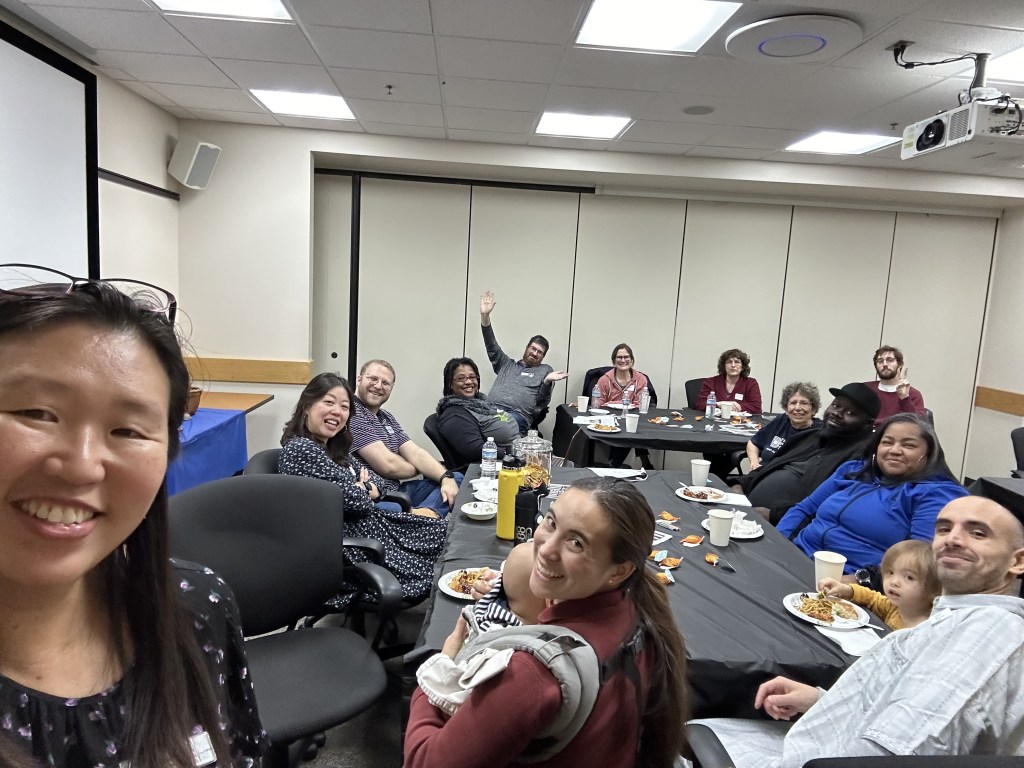
Kwanzukkah attendees pose for a mid-celebration photograph (photo by Christine Ngeo Katzman)
Sixteen people across a wide spectrum of ages and backgrounds came together to create a space where we can bring the fullness of our fabulous Jewish selves, including all of the messiness that makes us each who we are as individuals.
Kwaanzukka was an opportunity to bring all of the intersectional realities that people of color are never allowed to forget, but that is a reality of every life on this planet. Something evident in the rich conversation that ensued after bridging the land acknowledgment into an invitation to name the geographic places referenced at the event. From lands our ancestors originated, whether we had ever stepped foot on that land or not, to the cultural communities connected to the dishes we brought, whether those were our culture or not.
The responses were messy, full, and rich… from EVERY attendee. Affinity space is important. It is also important to have periodic open full-community events where Jewish people of color can show up in our fullness along with all of the people who love and support us, whatever their race or spiritual affiliation. To still center the voices and experiences of Jewish people of color and break down anti-blackness.
Jews of Color Sanctuary has done national virtual events which have been deeply meaningful for me. However, Kwanzukkah may be the only time I have ever felt like every part of me was welcome at an in-person event where I live. A simultaneously heart-breaking and exuberant statement. I lead this work because I need it in my life. I know it’s important because I see how powerful this work is in other settings across the country. Special thanks go to the JCRC and Federation for understanding the importance of creating events like this, and especially to each attendee… we created this space together and it could not have happened without you.
Jews of color… what kinds of events would be meaningful for your lives? Allies… please let the Jews of color you love know that JoC Sanctuary is their local resource and an opportunity to plug into the national networks of Jewish people of color from many backgrounds who are claiming their right to celebrate their Jewishness with the rest of their fabulous selves. We’re here for us.
After not being referenced to at all during the previous Parasha Miketz, Bilhah and Zilpah are drawn into the final parasha of their story moment only at the end literal recounting of the children they have produced. The Torah references wealth explicitly through the acquisition of cattle and slaves, and mentions of silver, but the currency that is never explicitly named are children.
Together, Bilhah and Zilpah birth one third of the Twelve Tribes namesakes. Beyond that as a focal stopping point, this inventory highlights that Bilhah and Zilpah left legacies that remain largely as invisible as they are. Zilpah and Bilhah would have been remembered by their children and grandchildren. Surely too, by great-grandchildren whose names have been severed from the record. Similar to the ways we say kaddish for those who have none, the Bilhah Zilpah Project dreams of remembering their names… not only for Bilhah and Zilpah, but also for ourselves.
Beyond the main narrative of Yaakov, Rachel, Lavan, and Leah, this foundational story of the Jewish people tells the stories within stories of Dinah and Yoseph. Growing up, leaving home in search of ourselves, and returning… if that is possible. Maybe going home is not about being back to be back, but to see and understand where we have gone, so we may continue. Bilhah and Zilpah’s story within the story is a crucial lens through which to see and understand our past, present, and future in order to better know ourselves, where we have been and where we are going.
Reflection Questions
• What makes a Jewish matriarch?
• How can we honor and celebrate Bilhah and Zilpah?
• What home do you need to leave in order to find yourself, or how does returning home help illuminate where you are going?
• Are children still our unnamed currency?
• Do we value women for more than just their ability to create life?
• How will you continue to listen for the silenced wisdom of Bilhah and Zilpah and other named and unnamed women of Torah?
Thank you for making this inaugural Bilhah Zilpah Homecoming such a sweet and memorable series. Your openness, heart, and wisdom helps to connect the ancient stories of Torah to the modern stories of our lives today, with a special invitation to reflect on the voices and experiences of the biblical characters we see as non-player-characters and their modern invisible counterparts. It’s an epic journey and it’s delightful to be accompanied. As we were all there at Sinai, so too Bilhah and Zilpah are connected back to us.
This is the last weekly email of Bilhah Zilpah season, but fear not… emails will switch to monthly for those who registered. Meanwhile, if you joined us along the way, check out the Vayeshev, Vayishlakh, Vayeitzei, and Miketz reflections… and keep listening for their voices. You can learn more about my journey with them in Bilhah and Zilpah Made Me Yearn For Torah published in the Jewish Women’s Archive.
May the light we kindle during the winter holiday season help us to draw near the wisdom of biblical women like Bilhah and Zilpah and see the Bilhah & Zilpah’s of today!
Guest blog by Christine Ngeo Katzman, Jewish Federation of Cincinnati
I’m Chinese-American, and my husband is Caucasian. A long time ago, we chose to raise our children Jewish. We have blended our cultures, celebrating three different New Year’s holidays, for example: the Jewish New Year of Rosh Hashanah in the fall, the Gregorian New Year on January 1, and Chinese New Year later in the winter. I have loved having three opportunities to start over. We also celebrate Christmas and Easter in secular ways.
In 2016, when my oldest daughter was 12, she announced an interesting idea: “Let’s invite all of our Jewish friends to come over for Chinese food on Christmas.”
At first, I laughed and dismissed it. But the more I thought about it, the more I realized that the concept was brilliant. After all, we didn’t have any plans to travel or host out-of-town family that year, and some Jews have a tradition of eating out at a Chinese restaurant for Christmas anyway. So, I agreed to her idea on one condition—that she help me cook.
She happily accepted, so we planned the menu as a family, bought all the necessary ingredients at the Asian market, and worked together for hours on Christmas afternoon to chop vegetables, marinate meat, and take turns stir frying as well as literally frying over the hot stove. My husband and younger daughter participated too.
We served lo mein, beef and broccoli, pot stickers, lumpia—Filipino spring rolls—as well as latkes. Lumpia is a particularly time-consuming but an important holiday food in our family. I am Chinese, but my parents grew up in the Philippines (also where I was born). And for dessert, one of our friends brought homemade sufganiyot (jelly donuts); we also served pie.
That year, the second night of Hanukkah fell on Christmas, making the evening even more special for all of us. Two additional families attended our Chrismukkah, and each family brought a Hanukkiah to light. Our bellies were full, the light shone bright, and we celebrated friendships and family.
We replicated this event one more time in 2018 and also included my sister, who was visiting from another state. Ironically, that day, we played the board game Pandemic together.
In 2022, I met Erica Riddick, founder of Jews of Color Sanctuary in Cincinnati. I had just recently changed careers and joined the Jewish Federation of Cincinnati as a Community Building Associate. Although we first met in passing at the JPro conference in May, Erica contacted me again in September to get to know each other better.
While I never thought of myself as a Jew of Color, the incidents of Asian Hate during the COVID-19 pandemic made me realize that minorities need to be allies with each other. During my meeting with Erica, I reminisced about my Chrismukkahs past and mused about how cool it would be to celebrate Christmas, Hanukkah, and Kwanza together. Here we are now, bringing that idea to life together in 2023.
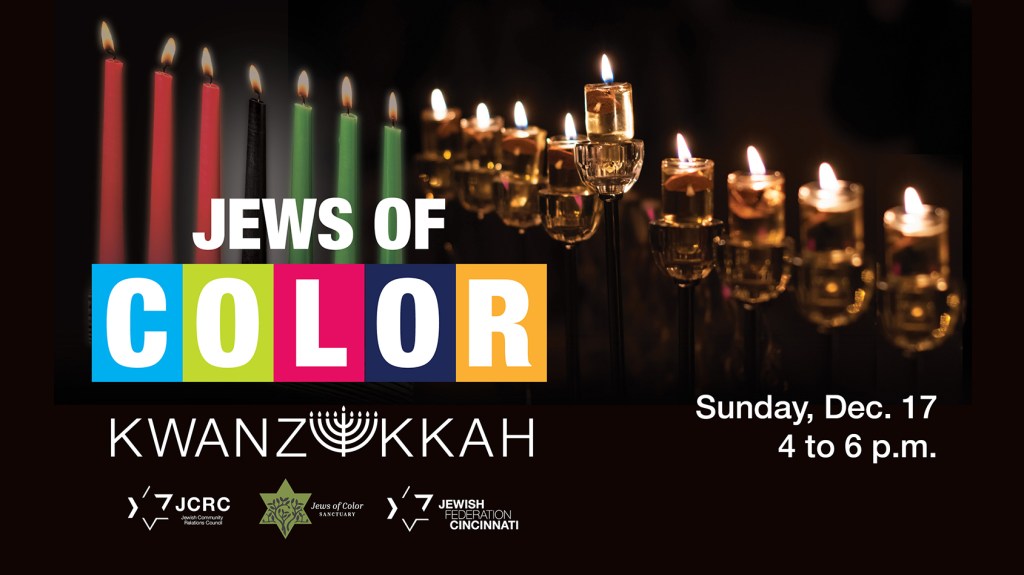
On December 17, I look forward to gathering with other Jews of Color to learn more about each other’s cultures as we combine for a wonderful Kwanzukkah event (which will include some Asian food as well), co-sponsored by the Jewish Community Relations Council, Jews of Color Sanctuary, and the Jewish Federation of Cincinnati. In this very difficult fall for Israel and for Jews around the world, I hope that these holidays filled with joy and light will bring us closer together.
In Miketz, named for the end of the two years Yosef has languished in prison, Pharoah’s Cupbearer finally remembers his promise and tells of Yosef’s ability to interpret dreams. Yosef’s insight led Pharoah to organize during the years of plenty to avoid devastation during the years of famine. This is how Yosef came to be in charge of Pharoah’s court at the age of 33. Pharoah renames Yosef, Zaphnat Paneakh, and gives his daughter Poti-fera as his wife.
Yaakov learns of food rations to be had in Egypt and sends ten of Yosef’s brothers to see about getting food to survive, choosing to hold back Benyamin for his safety. Yosef recognizes his brothers, but not they he. Yosef accuses them of being spies in order to see Benyamin. Yosef returns all the brothers, except for Shimon as collateral, with bags of grain and their payment returned, until they bring Benyamin.
Yaakov doubles down on lamenting consideration of sending Benyamin, now believing to have lost two sons, Yosef and Shimon. Reuven swears to Yaakov that he will protect Benyamin at the expense of Reuven’s two sons. Yehuda also says to send Benyamin with him, referring this time to Yaakov as Yisrael, vowing to be culpable for sin against his father for all days if Benyamin doesn’t return, referencing the time that has passed since they were asked to bring Benyamin. Yaakov resigns himself to more grief and finally allows Benyamin to be taken for more rations, now acknowledging Benyamin as having brothers.
Yosef sees his brothers coming with Benyamin and orders a feast be prepared. The brothers are directed into the house of Yosef and fear that the payment returned before was an omen they are to be enslaved through an interesting line that reads:
וְלָקַ֧חַת אֹתָ֛נוּ לַעֲבָדִ֖ים וְאֶת־חֲמֹרֵֽינוּ
his sign to be seized as slaves and with our donkeys
The brother’s speak to Yosef’s house man, return the coin, and explain what happened, to which they are told not to worry. Shimon reappears. The brothers wash their feet and prepare to eat with Yosef who now sees his brother Benyamin for the first time since being sold into slavery. Yosef goes off to cry by himself and returns. The Egyptians eat separately from the Hebrews…
And to the Egyptians ate together apart because they could not endure the Egyptians to eat bread with the Hebrews because it was disgusting to them the Egyptians
The brothers feast, and get drunk. Yosef’s goblet filled with silver is slipped into Benyamin’s sack at Yosef’s command when the brothers receive rations and depart to return to their father. Yosef sends men after the brothers and accuses them of stealing to which they say, hey, we returned the money we found in our packs from last time, why would we steal from you… if you find something, kills the one who has it and enslave the rest of us! Yosef changes the deal to the one with whom it is found shall become my servant but the rest of you shall be absolved. The brothers show their packs and the goblet is found with Benyamin. All the brothers return to Egypt and the house of Yosef. Yehuda prostrates himself and Yosef asks if they did not know he could divine. Yehuda begs and Yosef insists that Benyamin will stay and the brothers may return in peace to their father.
Previous Bilhah Zilpah Project emails opened with a drash on how to read the title of the parashat with them in mind. The idea of the end of imprisonment brings to mind if there is an end to enslavement for Bilhah and Zilpah. There were end periods to some enslavement under some circumstances and ways to end enslavement in other conditions. Do you have other creative drashes to bring in Bilhah and Zilpah? We’d love to read them!
Our main musing in this Bilhah Zilpah pesuk-less parasha is that the Torah says Bilha’s children were supposed to be attributed to Rachel, Yosef and Benyamin’s mother, who herself is also deceased… and the favored wife. If Dan and Naphtali belonged to Rachel, then Yosef still had brothers. For nuances like these, in addition to the fact that the Torah always notes Bilhah and Zilpah as the mother of their children, suggests that they were not only recognized as birth-mother, but also retained their status as parent. Does this moment feel bittersweet, given their status as wives and parents, in hearing confirmation that Yaakov values his children differently? If the wife/child ordering when meeting Esav had not already confirmed their understanding of who was not counted, who was worth sacrificing.
Reflection Questions
• How does Yaakov’s lamenting sending “his son” because his brother is dead affect Bilpah?
• How can we explore the status shifting that Bilhah and Zilpah experience, their naming by others, in relationship to the renaming of Yaakov to Israel (twice) by God and the renaming of Yoseph to Zaphnat Paneakh by Pharoah?
• What do you make of the brother’s lamenting of their feared enslavement along with their donkeys?
• Why do you think Shimon was the brother held back in Egypt? Do you think this was Yosef’s choice, the brothers, or custom?
• At the end, how long were Bilhah and Zilpah enslaved? Can you create midrash that brings Bilhah and Zilpah into the title of this parasha? We’d love to read them!
The last weekly email during Bilhah Zilpah season will also go out on December 17, but fear not… emails will switch to monthly for those who registered for those emails. Meanwhile, if you missed them, check out the Vayeshev, Vayishlakh, and Vayeitzei reflections…
Happy third day of Chanukah. May the light we kindle help us to see the Bilhah & Zilpah’s of today!
One of the unique qualities in the source sheets for the Bilhah Zilpah Project is that they only include the Torah lines that reference Bilhah, Zilpah, or their children. As characters that have always been there, but whom often have to be introduced when brought into Torah study, this choice was an attempt to keep the focus on Bilhah and Zilpah.
Next Shabbat, we read Vayeshev, which contains a single line invoking Bilhah and Zilpah. Breishit 37:2 finishes the long accounting of the descendants of Yaakov that ends Vayishlakh. The line returns Bilhah and Zilpah to the status of wives.
The parasha is named for the opening line he dwelled. Bilhah and Zilpah dwelled as well. We learn that Yosef is seventeen. This can help us guess minimum ages for Bilhah and Zilpah. By now, these women have now dwelled through multiple stags of their lives and enslavement to reside as concubine matriarchs of one third of the twelve tribe namesakes.
The feud between Rachel and Leah lives on through Yaakov’s children even after Rachel’s death. Yosef is identified as being the favored son (of the favored wife). However, the line also suggests that Yosef worked alongside Bilhah and Zilpah’s children in specific tasks of tending the sheep. The negative reports could be of all of the brothers, but why mention Bilhah and Zilpah if not to indicate that the report defames Dan, Naphtali, Gad, and Asher? The children were named after all, not for hopes of their futures, but for how Rachel and Leah hoped their births would affect their relationship with Yaakov, even the children of Bilhah and Zilpah.
Despite the Torah laying out the intention that Bilhah and Zilpah’s children would belong to Rachel and Leah, Bilhah and Zilpah appear to have retained their status as mother. However, this line invites consideration for if their children were seen differently and for the legacy of how these children were named.
Reflection Questions:
• What do you notice in the begetting accounting, especially relative to Bilhah and Zilpah?
• How have the status of Bilhah and Zilpah changed over time?
• What clues do we have about the relationships Dan, Naphtali, Gad, and Asher had with their brothers?
Meanwhile, look out for our next Bilhah Zilpah Project email on Sunday December 10. And, if you missed it, check out the Vayishlakh and Vayeitzei reflections…
Parashat Vayishlakh is named for the opening Hebrew indicating that Yaakov sent messengers with gifts to help ease the reunion with his brother Esav with whom he is unsure how he will be received. There is so much focus on the different types of cattle that it can be easy to miss that a male and female slave were included in the goods sent. By now, we are accustomed to cattle and slaves being an indication of wealth. I find myself wondering how customary it may have been to give slaves in this manner? After all, Bilhah and Zilpah were given as gifts by Lavan to his daughters. Why not between brothers? Would this have been different in a context that was not among close relatives? What was it like for the two enslaved people who were sent to Esav? Did they have family that remained with Yaakov? How did Bilhah and Zilpah and other enslaved people feel at seeing this exchange?
Like Vayeitzei’s going out was also significant for Bilhah and Zilpah, Vayishlakh can be read in their eyes too. In his lingering unease, Yaakov splits his camp and sends Bilhah, Zilpah, and their children out front. With Leah and her children in the middle, and Rachel and her child last. The Hebrew is not the same shoresh for send, using instead שׂוּם (shoom) to put. However, it is very much a choice that, in the event of Yaakov’s worst fear happening when he hears that Esav is heading toward him with 400 men, would send Bilhah, Zilpah, and their children to face a potentially tragic fate that would give Rachel and her child more chance to avoid, especially with the added buffer of Leah and her children.
This choice happens immediately after Yaakov has focused on his family, even if framed as his belongings, and wrestles with God. This line has inspired kashrut and much focus given its coinciding with the name God gives Yaakov, never mind that we rarely use it. I think there is room to see the wrestling as that of a father and a husband who is afraid, who does have different relationships with his wives… and his children because of their different relationships with those wives, and makes a revealing choice.
We know that Esav is delighted to see his brother Yaakov. Despite the warmth of this reunion, Yaakov chooses not to stay with his brother, but go off on his own. This brings us to the story of Dinah which can also be very interesting through the eyes of Bilhah and Zilpah. Seeing Dinah’s body being controlled by Shechem, and her fate determined by her brothers. Hearing of the dowry promised for Dinah, having received no dowry themselves. Potentially, serving as the dowry of Rachel and Leah. Whatever Bilhah and Zilpah’s relationship may have been with Dinah, I wonder how these moments were experienced by them? There is an invitation to consider how these three women may have supported each other through the absence of their voices during fates.
Reflection Questions:
• How do you read Yaakov’s choice to put Bilhah and Zilpah out front when the family meets Esav?
• How does putting Bilhah and Zilpah “out front” play out in modern situations?
• In what ways do we use different categorizations of people/community to create “buffers” between situations we are unsure of or perhaps even actively avoiding?
• We like to think of enslavement as structurally different than that of the Trans-Atlantic Slave Trade… what differences are there… what similarities?
• Where do you see possibilities for female solidarity that merit deeper reflection?
Parashat Vayeitzei is named after it’s opening word וַיֵּצֵ֥א (Vayeitzei) He went out…
Toldot, the parashat before Vayeitzei, read this past Shabbat ends with Yaakov fleeing his brother Esav and his home to go live in Padan Aram with his uncle Lavan and instructions to find a wife.
Vayeitzei opens where the previous section ended, with Yaakov went out from Be’er Sheva toward Harran, the city in Padan Aram where Lavan lives. In this parasha, which we will read next Shabbat, Yaakov meets and falls in love with Rachel and ends up married to both Rachel and her sister Leah. We meet Zilpah and Bilhah on each sister’s wedding night.
Vayeitzei is the where the main lines which reference Bilhah and Zilpah reside, in Breishit 30:3-30:13. Amidst children being named as commodities for attention in the war waged between Rachel and Leah. Bilhah and Zilpah find ways to navigate their shifting status between slave, concubine, and wife.
We are more than our circumstances. Bilhah and Zilpah were more than enslaved people, used as a sexual commodity. Bilhah and Zilpah were multidimensional women who found ways to navigate the realities of their lives. They were women who existed within relationships and left legacies. Bilhah and Zilpah went out into the world—at least encountering the world between Padan Aram and Hakhanim in their traveling, dwelling, and working.
Bilhah and Zilpah’s experiences align with many modern women in not having autonomy over their bodies, being named and categorized by others, having their voices silenced, and feeling invisible in plain sight. They can be a lens through which to explore slavery, human hierarchies, belonging, disenfranchisement, and fucked-up family dynamics in Torah and the ways these topics continue to echo throughout history up to the present.
Choosing to read Bilhah and Zilpah with power and autonomy helps me do that for myself in my own life—still living within a racialized world, yes, but able to find ways to navigate institutionalized systems of racialized oppression with moments of power and autonomy that allow me to make choices—or at least the best choices at my disposal today, to live the best life I can while also trying to seed greater choice for those who come after me.
How do you see the story…?
Reflection Questions:
• What was it like to be used to bear children intended for others?
• What ways were Bilhah and Zilpah’s life different and similar to Rachel and Leah?
• Are Bilhah and Zilpah seen as the parents of Dan, Naphtali, Gad, and Asher?
• How did the children feel in this situation?
• Bilhah and Zilpah and the children born through them are commodities in this story… yet, is there a way to read Bilhah and Zilpah with autonomy?
Join Jews of Color Sanctuary at this open Homecoming event welcoming Bilhah & Zilpah as they enter the Torah in Parashat Vayeitzei.
Come to hear what has been going on with the Bilhah Zilpah Project over the last year, learn some Bilhah Zilpah wisdom for our modern lives, and leave with a new relationship to these matriarchs. This time, let’s read the story through their eyes…
Register for the independent events in this series:
Bilhah & Zilpah Enter: A Homecoming Celebration Sunday, November 19 at 9-11 a.m. PST / 12-2 p.m. EST / 6-8 p.m. IST
Bilhah Zilpah Dreaming: Creative Play for Reclamation Sunday, December 3 at 9-11 a.m. PST / 12-2 p.m. EST / 6-8 p.m. IST
Bilhah & Zilpah Drew Near: Listening for Torah Women’s Wisdom Sunday, December 17 at 9-11 a.m. PST / 12-2 p.m. EST / 6-8 p.m. IST





 Jews of Color Sanctuary