I am a Jew who also happens to be a person of color. I am a cerebral, creative, ambi-brained designer by day and ballroom dancer, improv performer, gamer by nights & weekends. I have a penchant for asking questions, seeking engaged conversation, and reading whatever calls to me, but have a special place in my heart for young adult dystopian multi-verse romance fiction. I believe "it takes a village" and interpersonal relationships are the entire point of life. I live an unplugged simple life in Cincinnati Ohio USA.
JoC Sanctuary co-facilitated a niggun creation workshop, with ish and Birds of a Feather, in preparation to welcome Little Amal’s journey highlighting the realities of refugees. Cincinnati Mayor Aftab Purval greeted the Syrian girl and shared words of welcome, speaking also as the son of parents who a generation before had been an immigrant and a refugee.
photo by Cincinnati Chamber Orchestra
Jewish people of color are often forced to navigate the cultural threads of their interwoven composite identities in ways that help empathize and understand the circumstances that create refugees and seeking to reconnect with lost family. Sharing a border with Israel opposite Egypt, Syria is close enough to mingle with Jewish narratives in Israel, and beyond.
While Little Amal remains on the move searching for parents after being separated through war, Cincinnati Jews and allies can support refugees in our community through Refugee Connect, a nonprofit that coordinates the efforts of partner organizations and volunteers. This network serves the more than 25,000 displaced people resettled in our region.
These events framed entering into Rosh Hashanah and Yom Kippur. Our personal and collective prayers for redemption are entering into conversation under the stars over our sukkot. May our ushpizin help us connect with where we have been as we discern the path toward collective liberation. We have an opportunity to invite more than Jewish men, and think beyond Jewish women elevated in Torah to include
We have an opportunity to think beyond the Jewish men elevated in Torah, and the women added later, to invite other characters who can help us weave our requests for forgiveness into redemptive action. Bilhah and Zilpah, our inconsistently acknowledged Jewish matriarchs have a lot to say through their voiceless lines of Torah. Sukkot is a sweet time to listen.
I have long been a fan of mussar as a Jewish spiritual practice that can help us strive to be better versions of ourselves through concentrated reflection and practice. Like in the ways we practice math, life, or Judaism. We like to say practice makes perfect, but it really makes better.
That first mussar group for me was in Cincinnati at Lloyd House organized by a beloved ally. I loved it AND there were also moments when it was clear that my experiences as the lone black participant were just too far removed for the rest of the group to really be able to hear. Fast forward several years to Israel where my studies led me to a deeper connection to Chasidut, not as something that others did, but aspects of my own practice which had always been there. Skip ahead a year to my first mussar group in an all-black Jewish setting… life changing!
That mussar group was facilitated for the Black Jewish Liberation Collective by Dismantling Racism from the Inside Out (IOWA), a project of Inside Out Wisdom & Action (DRIO). While a personal practice, mussar benefits from group support elements that fulfill a witness and accountability partnership role which feels important to me. This was the element that had been missing in my first mussar experience. Falling in love with mussar through my first experience despite lacking community support testifies to the power of this practice. Finding community made mussar even more magical.
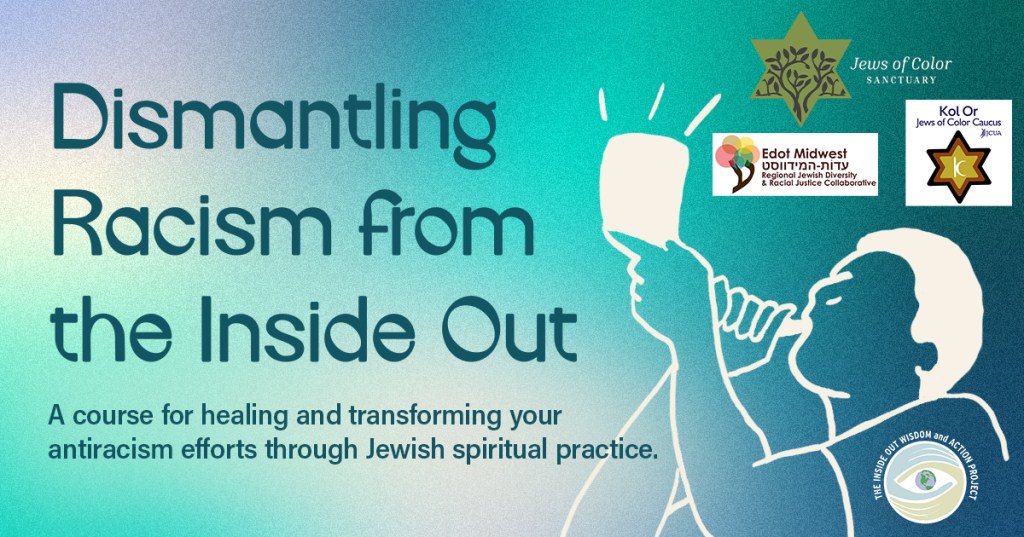
It is with this deep personal knowing that I am proud to announce that Jews of Color Sanctuary is partnering with Edot and Kol Or (the Jews of Color (JoC) Caucus of Jewish Council on Urban Affairs (JCUA)) in offering an affinity space DRIO Midwest PoC Cohort that will start November 7, 2023. This course is intended to build on an existing antiracism foundation–this is not an antiracism 101 course. This will be a unique and important opportunity to build relationships and infrastructure among Midwest Jewish people of color communities which often doesn’t happen with the value bias that keeps focus and resources in coastal Jewish communities.
As our thoughts and preparation shift toward 5784 acknowledgement of collective sins and our community need to address wrongs and work towards building the world of tomorrow today, I invite you to join us. There is no better way to bridge the concepts of betzelem Elohim, tikkun olam, and not standing idly by than honing the ancient Jewish wisdom of mussar in service of our anti-racist work. The words of a past participant speaks to the power of this program better than anything else.
Allies too can support this project in a variety of ways. JoC friends and family always need your kindness and loving support especially while one is actively engaged in dismantling internal racialized systems of oppression. Ask how the va’ad is going, plan regular check-ins, share your own anti-racist journey reflections. And, if you have the ability, you can contribute financially to the materials and facilitator fees, through the cohort registration portal, which will make the accessible sliding scale of this va’ad possible.
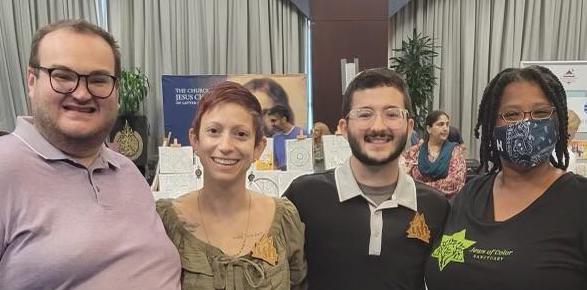
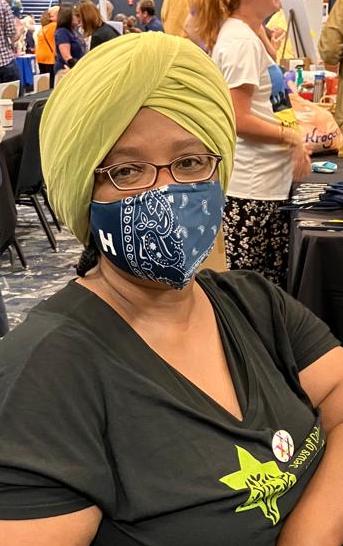
This past Sunday August 27, Joc Sanctuary joined the ish table with fellx grantee Elech at Festival of Faiths, “celebrating our community’s religious diversity”. It was refreshing to be in this interfaith space, put on by EquaSion, focusing on equality, spirituality, and inclusion, and see more than the diversity of Christianity. While busy spreading the word about JoC Sanctuary, I was able to walk around a little, including visiting a Bahai table and also a few Sikh tables, one of which wrapped me in a turban.
This was a sweet kind of homecoming where I ran into many people I already know from different backgrounds and faiths and connected with those who I hope become new friends.
I’m excited to share a ground-breaking research project to learn how Jewish people of color (JoC) engage with Jewish end-of-life rituals and practices. Ultimately, this information will inform the creation of resources most needed and desired to support Jews through this time.
I invite you to share the survey with your networks using sample language and social media formatted images in our Media Kit to help facilitate sharing.
Thank you for supporting and reflecting the diversity of the #JewishCommunity.
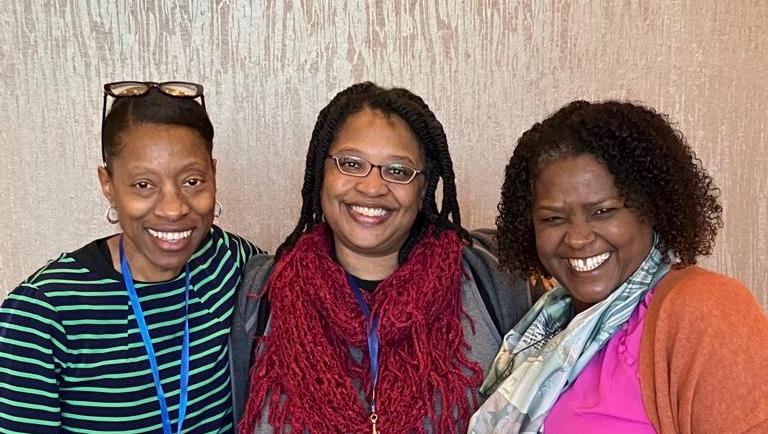
Last week for me began in Atlanta at a Full Disclosure Facilitator training led by Barbara Rosenblit and Sheila Miller who were sharing their process of artistic storytelling as a way to create connection, honor community, and preserve history. This collaborative experience with Jewish Women’s Archive’s Story Aperture application was rich and engaging. The three-day training gave me the gift of a full day of creative process which is precious, even for someone who is constantly involved in creative work. I was excited to meet two Jewish Women’s Archive colleagues, CEO Judith Rosenbaum and Program Director Betsy More, for the first time in-person! And, this was also a rare moment at an event not specifically designated for Jewish people of color where, among ten amazing participants, I had the pleasure of spending time with Victoria Raggs of Atlanta Jews of Color Council and Shula Mola, a Beit Israel scholar preserving the histories of Ethiopian Jews in Israel from the historic Jewish village of Enkash.
Victoria Raggs, Erica Riddick, Shula Mola (l-r)
The word pentimento, which Merriam-Webster online dictionary defines as “a reappearance in a painting of an original drawn or painted element which was eventually painted over by the artist” was introduced through the title of the presenters’ book, Pentimento-Revealing Women’s Stories. The concept of pentimento makes me think of how Jewish people of color have been obscured from a narrative that continues to be white-washed so pervasively it has colored the imaginations of people of color. I appreciate having another tool in my toolbox to support the endeavor of revealing stories that have always been there.
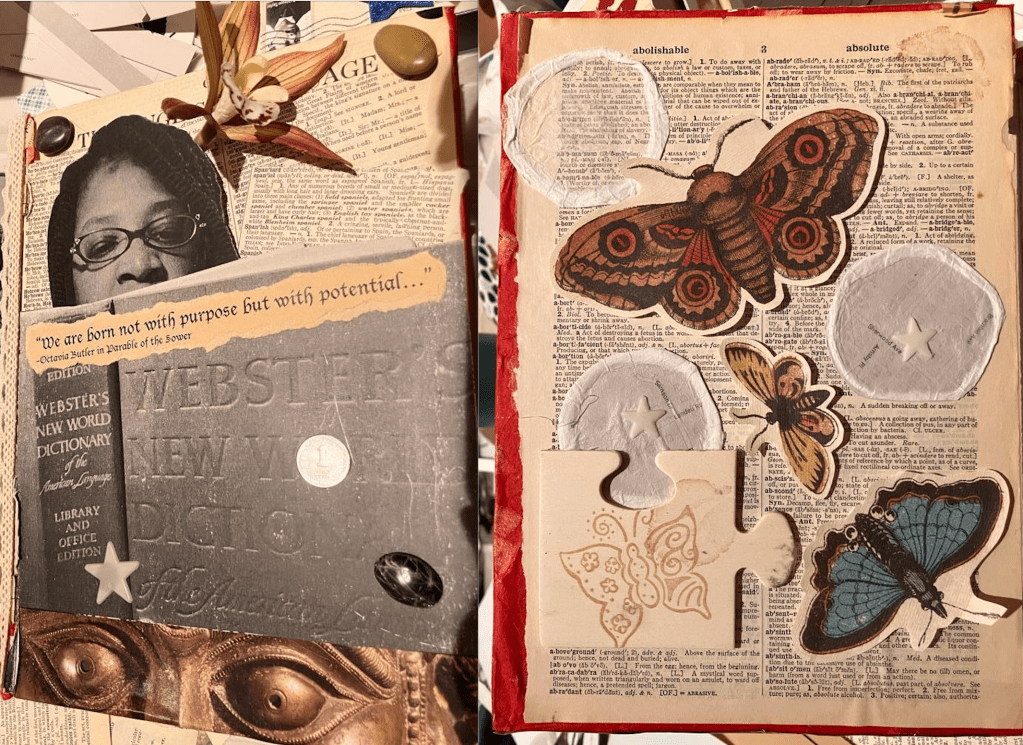
I was intrigued when I first received the list of materials to bring with me to the training… five self-portraits of me with encouragement for playful experiment (perhaps my two favorite words in succession), words that speak to a personal philosophy, three-dimensional items to embellish the piece, and an object to introduce myself. Many women continued their introductions into their self-portrait piece which was a wood box in the shape of a book with a hinged lid. My project followed suit in a way. I had introduced myself through my love of libraries, noting a particular fondness for dictionaries. The photograph I selected for the lid was me holding my favorite dictionary, a gorgeous pale blue bound embossed Webster’s New World Dictionary of the American Language circa 1950s. In a moment of symbiotic presence, Sheila brought along a 1938 dictionary for participants to use to add meaning. My cover materialized with an energy of its own… My book box was embellished with beloved quotes from Octavia Butler, Audre Lorde, Michael W. Twitty, and more; small rocks; and butterflies. The interior of the box includes a cartographical history, linking my love of books and maps through a geographically imprint.
One of the best parts of the experience was, after sharing and listening to other participants as they constructed their projects, we witnessed the completed (or in-process) work and what the artist chose to share about the piece with those assembled. I am a performer who understands the importance of having an audience to receive you. As part of the current Jewish Studio Project, Creative Facilitating Training cohort, I am understanding deeper nuances of how generative being a witness to someone’s creative practice can be. I am giddy at the interplay between the artistic spaces I inhabit and the role creativity plays in everything I do, and all that I am.
My self-portrait book remains untitled and still needs an artist statement, but I am excited to share and facilitate this practice. Upcoming events will offer ripe opportunities to share this tool with artists, historians, and storytellers of all ages. This year the theme of the Jews of Color Mishpacha Project, JoCISM Shabbaton over June 16-18 is “We Are Family”, which will be immediately followed by a LGBTQI Juneteenth celebration of “Collecting Our Stories”, and immediately preceded by the launch of the Black Jewish Liberation Collective, Dismantling Racism From the Inside Out, a joint organizer mussar va’ad. Jews of Color Sanctuary is collaborating with Edot and Kol Or, the Jews of Color Caucus of the Jewish Council on Urban Affairs, in the development of a Midwest mussar va’ad–one of many ways to bring national initiatives home to Cincinnati after transporting a taste of the Midwest to the world.
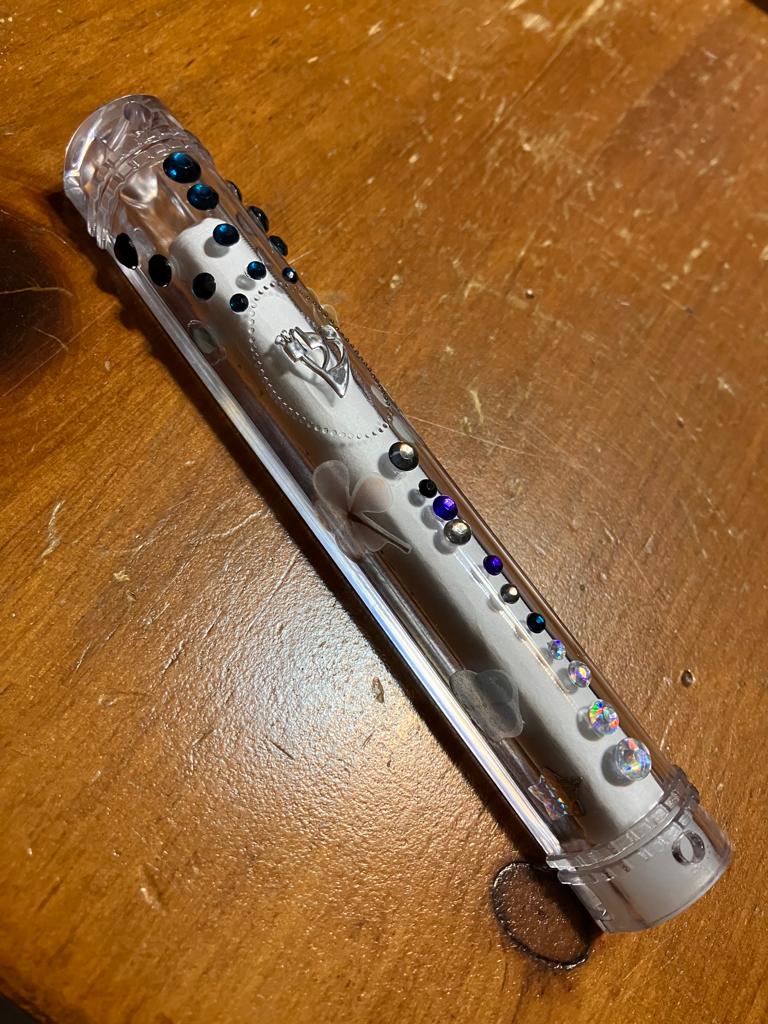
I am in the beginning moments of reflecting back on what I want to take with me into Shabbat and what I wish to leave behind as I close my week. I smile as I recall how my week started with JoC Sanctuary Ritual Studio. A program called Mezuzah Bedazzle. Creation is a beautiful and powerful thing. Perhaps that is why we start there in our annual reading of Torah. The act of making can also calm us as it gives us something to do with our hands, and perhaps a way to make sense inside our minds. Somewhere along our journey into adulthood, many give up the simple joy of making for making’s sake. Witnessing this tendency interrupted is a precious moment during a session of Mezuzah Bedazzle–seeing adults allowing themselves to play. When children attend, they take to the task easily. Adults often need more time, but always arrive. And, in the midst of joyful gathering and separating and imagining creation making with intention we studied about mezuzot, and had conversations with each other–learning, listening, laughing… This is what I’m bringing in to spark Shabbat!
In the way that we are made in the image of God, and perhaps God also holds parts of us, may we reflect aspects of our children as we mold them into adults. In a world filled with too much sorrow may we give ourselves the gift of choosing simple joys all around us, even if we have to mimic our children until we find our way. May we choose to embrace ritual in ways that are meaningful for our lives and relish opportunities to listen and learn from the wisdom of every person, seeing God reflected in each face. May our spiritual sparkle bedazzle our world.
The universal human relationship with water is revered in many cultures for connection, purification, cleansing, transition & wisdom. During ritual immersions, physical barriers are removed between our body and the water. This series is a moment for attendees to remove mental or spiritual barriers from past experiences and deepen their relationship with Judaism and this ancient tradition. The communities where guides live can continue to support removing barriers as you welcome and celebrate these “mikveh guides as wisdom-holders and educators” attracted to this learning because they are already vibrant participants in their Jewish communities.
Program design development and implementation planning was a big job. For this community that means the world to me, it was important to create a space where every individual could bring the full-fabulousness of their beautiful selves completely into the space and learn from the course, each other, and themselves. It was worth it to read feedback confirming that 100% of participants felt a sense of belonging, 100% would recommend the program to a friend, and 92% learned something new. What I didn’t expect was how much this work for others would also feed my soul. I had the opportunity to create an opening ritual and prayer which feels bigger than the specific moment it was created for. May its words nourish our souls in ritual moments we need to hold us…
May we remember that the waters of Gan Eden still flow through our bodies and the earth,
the four rivers of Pishon, Gihon, Hidekel, and Perat.
May we allow those ancient waters to connect us to our ancestors and our first home,
lands of gold and precious resource, lands of Ethiopia, lands of Assyria.
May we use our knowledge to protect the source and follow the water to life,
with gratitude for the waters that hold us and the heavens that give us breath.
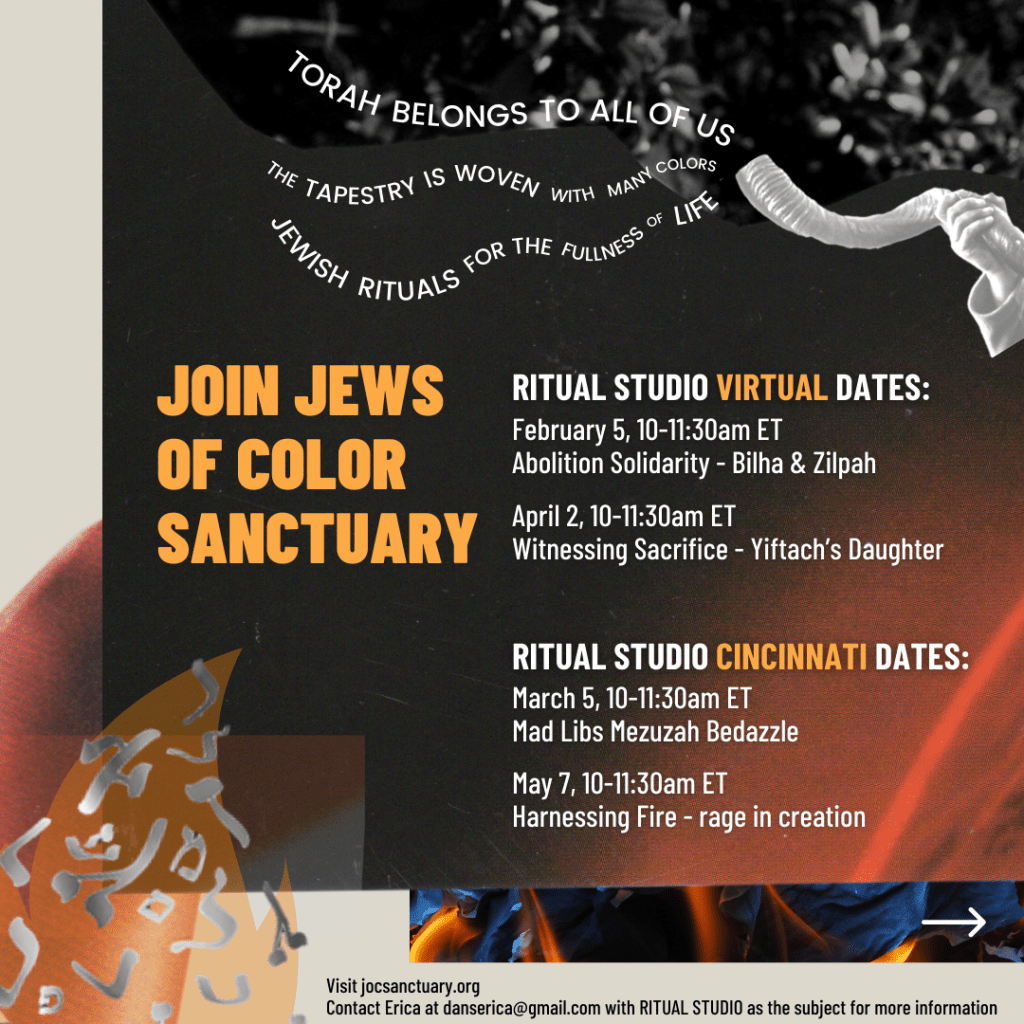
Join Jews of Color Sanctuary on 1st Sundays in 2023 for an interactive Ritual Studio experience centering Jewish people of color, skills for creating Jewish ritual, and a sprinkling of art and Torah.
Jewish people of color can register for this affinity space for all levels of art and text study experience. Half the sessions are virtual to allow cross-pollination community for Jewish people of color around the world. Greater Cincinnati Jewish people of color are welcome to register for all four sessions. Participants who attend both in-person or both virtual sessions and participate in the studio by sharing images of their work are eligible for artist stipends of between $15-30.
From left, participants in the JOC Mishpacha “We Are Family” JOCSM Shabbaton: Maetal Gerson, Avodah Jewish Service Corps Chicago, and Kol Or of JCUA; Denise Dautoff, Jewtina y Co.; Riki Robinson, Jews of Color Initiative; Ari Monts (kneeling); Mackenzie Martinez, Avodah Jewish Service Corps, San Diego; Sabrina Sojourner, co-founding director, KHAZBAR; Erica Riddick, Jews of Color Sanctuary; Deitra Reiser, founder, Transform for Equity; Kiyomi Kowalski, co-founder, Jewbian Princess; and Ramona Tenorio, Tiyuv Initiative.
I feel blessed to be connected with a national network of Jews of color (JoC) and lucky to have experienced JoC majority spaces, even if sparsely. It is joyful to feel community in a way that you know deep in your bones includes you. The JoC Mishpacha Project JoCISM Shabbaton was definitely that kind of event. It was an opportunity to deepen existing relationships and create new ones. I was struck by the harmonies we made together, both in song and the ways we blended needs and customs. It was also a beautiful expression of the crucial role allies play, as family, as friends, as organizations, as symbiotic supporters of this work to create affinity spaces that strengthen so much more than just the Jewish people of color present, but returns with them into their home communities… whether that is across the country or down the street. The weekend reminded me of the importance of the work of JoC Sanctuary and the ability to intentionally create the spaces we need for ourselves.
Erica Riddick of Jews of Color Sanctuary will be a featured speaker of the Co-Creating Rituals Panel at the Rising Tide Open Waters Mikveh Network virtual 2022 Gathering on May 9 through 10. Rising Tides mission is to inspire, strengthen and support communities that embrace an open, inclusive and welcoming approach to ritual immersion as a way to mark life transitions, believing that providing for the spiritual needs of the entire spectrum of Jewish people will help create a more vibrant, welcoming, and inclusive community for everyone. The gathering is an opportunity for individuals and groups to come together to learn from and grow this movement.