Teshuvah Across the Waters (TAW) is an exciting opportunity to bridge African diasporic Jews/Hebrews with African Jewish/Hebrew communities.
As a Jewish person of unknown African and Indian heritage, I have deep yearnings to experience ancestral Jewish traditions that have been severed through colonization, enslavement, and assimilation. Supporting the connections that will be forged through this project will enhance global Jewry’s collective efforts of Teshuvah, aligning values and relationships with ourselves, God, and the world.
TAW seeks to strengthen bonds across the Jewish Diaspora by lifting up the traditions and histories of African Jewry within the global Jewish community needed for an holistic and thriving Jewish peoplehood on our path toward spiritual redemption. Please join the incredible support for this project to increase connection our collective Jewish ancestry. A financial contribution of any amount can help us bridge these waters.
guest blog by Tamar Ghidalia & Jill Housen, 3W Consulting
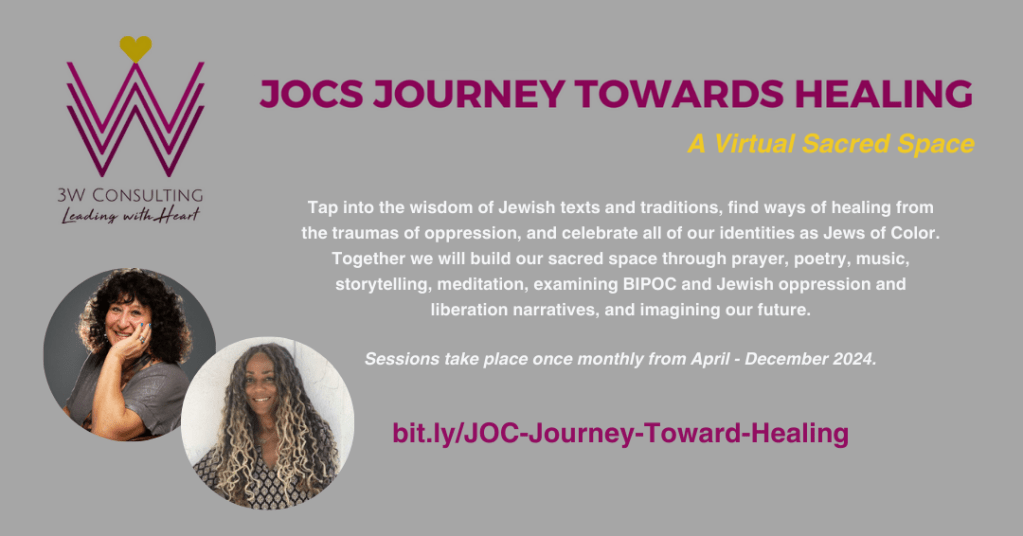
3W Consulting‘s work is anti racist and anti-oppression work and uses liberatory practice at its core. Since the work is significantly grounded in Jewish life, tradition, texts and values, it enriches the spiritual life of the participants and allows them to claim their Jewish identities.
We have served 20 organizations over the last 3 years: congregations, communal organizations, schools,camps, and presented at national conferences. We intentionally support and center JoC’ leadership.
We created JoC Journey Toward Healing because of the need of JoC to have places to just be and share their identities in a safe space. We believe that JoC are deserving of care and joy, feeling seen, heard and understood, feeling empowered and not alone…
By tapping into the wisdom of Jewish tradition and texts, we can find ways of healing from the traumas that we have faced and be able to bring forth all of our identities. Together we can build our sacred space through prayer, poetry, music, storytelling, meditation, comparing the BIPOC and Jewish oppression and liberation narratives, and sharing our dreams of liberation.
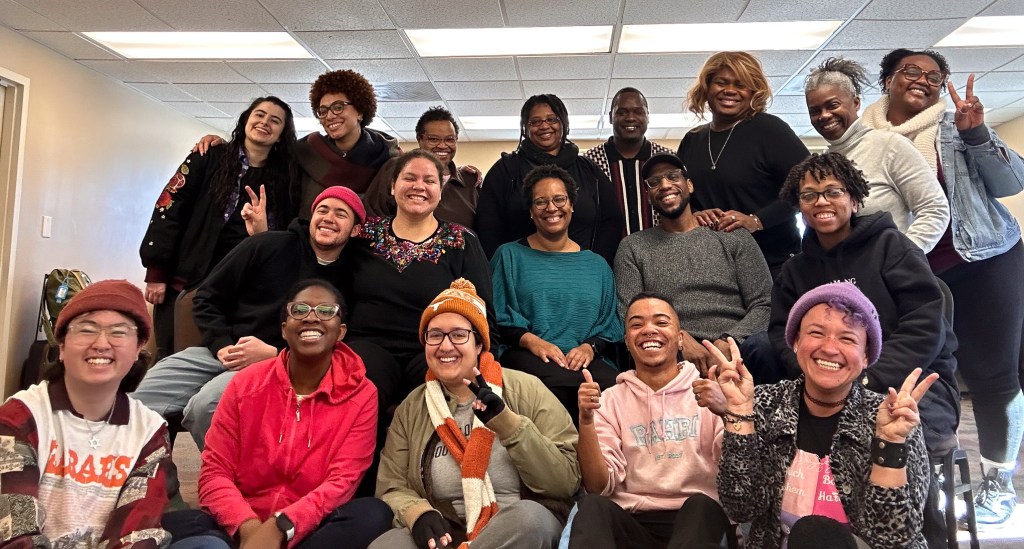
Keshet hosted Keshet Neshamot / Rainbow Souls Shabbaton: a Retreat of Radiant Belonging February 16 through 18, 2024 at Pearlstone Retreat Center in Reistertown Maryland. Attendance was aspirationally capped at 30 participants in the planning stages. Ultimately, 90 people completed the form to attend. We came from across the country for a taste of community. This was the first Shabbaton for some, a reunion for others, and a beautiful opportunity for all to bring our full selves into Jewish space.
If you have not heard Keshet, a national group working for LGBTQ equality in Jewish life, has a new Jews of Color Programs Manager in Sage Cassell-Rosenberg who collaborated with other keshet neshamot to create the best Shabbaton I have EVER attended!
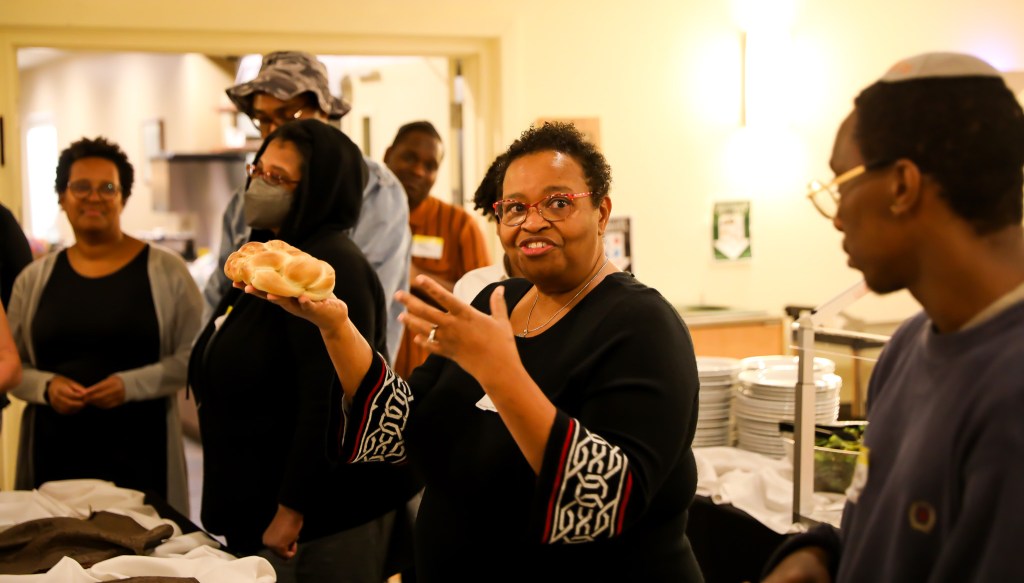
HaMotzi led by Harriette Wimms over our challot (photo: Brittany Maxson)
It began with baking challah, a precious way to ground us in ritual and meaning while literally making Shabbat together with collective hands. This opening was shephered by Harriette Wimms, founder of the Jews of the Jews of Color Mishpacha Project (which has been hosting an annual Shabbaton since 2020, the next one coming up July 12-14, 2024) and Kohenet serving on the board of Beit Kohenet.
Kabbalat Shabbat was led by Joshua Maxey, Executive Director of Bet Mishpacha of Washington DC using their amazing siddur from this egalitarian queer community founded in 1975. We used the Shabbat and Havdalah Guide for BIMPoC & BIMPoC LGBTQIA+ Jews on Shabbat morning, led by the guide’s creator, Kadijah Spence. Version 2 of the Shabbat and Havdalah Guide has been updated to include transliteration for Hebrew and the Hebrew alphabet.
Shabbat Guide created by Kadijah Spence & Shavat va-Yinafash siddur of Bet Mishpacha (photo: Brittany Maxson)
Shabbat afternoon was filled with more activities of connection and belonging. Is Perlman, Keshet Youth Intern, led a powerful, rich, and inclusive Identity Mapping session to embrace the richness of our diverse intersectional identities. Enzi Tanner staff of Bend the Arc and somatic fellow with Mitsui Collective led a session focused on caring for ourselves and our communities, bridging Jewish text, wisdom, and tradition with modern physical and psychological well-being practices. Sage invited us into one-on-one engaged sichot (conversation) sessions with guided prompts.
Later, Sage wove in Jewish teachings as our hands made our own Havdalah candles which ignited our closing of Shabbat. Story District highlighted the importance of our stories through a group activity before featuring Stories For Liberation told by five of the Shabbaton participants: Sage Cassell-Rosenberg, Samiah Fulcher, Is Perlman, Kadijah Spence, and Harriette Wimms. We celebrated new and deepened connections late into the night. Our departing Sunday morning closing session, titled Shrugging Off Imposter Syndrome and Owning Your Badassery by Kiyomi Kowalski, was sadly cancelled due to illness. There are plans to reschedule this session virtually which can expand the Shabbaton community.
Storytellers: Harriette Wimms, Sage Cassell-Rosenberg, Kadijah Spence, Samiach Fulcher, Is Perlman with Scott Hollingsworth of Story District (photo: Brittany Maxson)Havdalah over handmade braided candles (photo: Brittany Maxson)
Jews of Color Sanctuary is proud to be a connected partner in the national Jewish people of color landscape, bringing a taste of the community we can have here in Cincinnati and the Midwest. We are just finishing the Dismantling Racism from the Inside Out, Midwest JoC affinity mussar va’ad, in collaboration with Kol Or of the Council on Jewish Affairs in Chicago and Edot in Milwaukee, with support from Jews of Color Cleveland. Jews of Color Sanctuary is considering launching an open in-person Cincinnati cohort or a virtual Ohio cohort and we’d love to talk with you about it. There is so much possibility and we get to chart our present into the future!
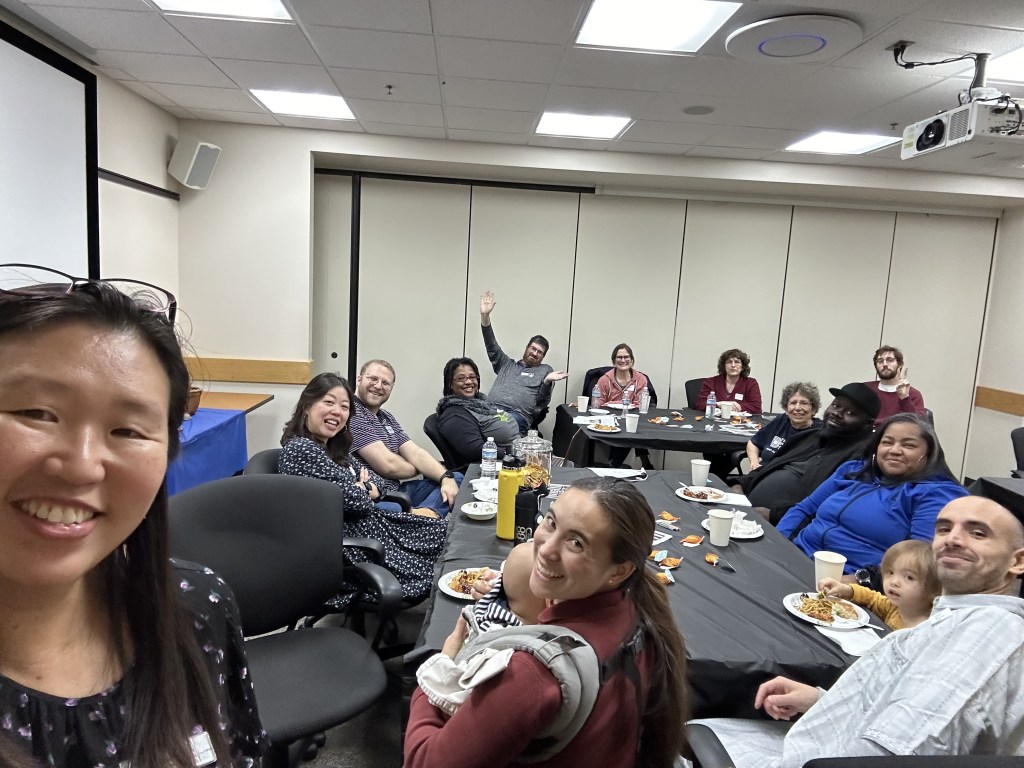
Kwanzukkah attendees pose for a mid-celebration photograph (photo by Christine Ngeo Katzman)
Sixteen people across a wide spectrum of ages and backgrounds came together to create a space where we can bring the fullness of our fabulous Jewish selves, including all of the messiness that makes us each who we are as individuals.
Kwaanzukka was an opportunity to bring all of the intersectional realities that people of color are never allowed to forget, but that is a reality of every life on this planet. Something evident in the rich conversation that ensued after bridging the land acknowledgment into an invitation to name the geographic places referenced at the event. From lands our ancestors originated, whether we had ever stepped foot on that land or not, to the cultural communities connected to the dishes we brought, whether those were our culture or not.
The responses were messy, full, and rich… from EVERY attendee. Affinity space is important. It is also important to have periodic open full-community events where Jewish people of color can show up in our fullness along with all of the people who love and support us, whatever their race or spiritual affiliation. To still center the voices and experiences of Jewish people of color and break down anti-blackness.
Jews of Color Sanctuary has done national virtual events which have been deeply meaningful for me. However, Kwanzukkah may be the only time I have ever felt like every part of me was welcome at an in-person event where I live. A simultaneously heart-breaking and exuberant statement. I lead this work because I need it in my life. I know it’s important because I see how powerful this work is in other settings across the country. Special thanks go to the JCRC and Federation for understanding the importance of creating events like this, and especially to each attendee… we created this space together and it could not have happened without you.
Jews of color… what kinds of events would be meaningful for your lives? Allies… please let the Jews of color you love know that JoC Sanctuary is their local resource and an opportunity to plug into the national networks of Jewish people of color from many backgrounds who are claiming their right to celebrate their Jewishness with the rest of their fabulous selves. We’re here for us.
After not being referenced to at all during the previous Parasha Miketz, Bilhah and Zilpah are drawn into the final parasha of their story moment only at the end literal recounting of the children they have produced. The Torah references wealth explicitly through the acquisition of cattle and slaves, and mentions of silver, but the currency that is never explicitly named are children.
Together, Bilhah and Zilpah birth one third of the Twelve Tribes namesakes. Beyond that as a focal stopping point, this inventory highlights that Bilhah and Zilpah left legacies that remain largely as invisible as they are. Zilpah and Bilhah would have been remembered by their children and grandchildren. Surely too, by great-grandchildren whose names have been severed from the record. Similar to the ways we say kaddish for those who have none, the Bilhah Zilpah Project dreams of remembering their names… not only for Bilhah and Zilpah, but also for ourselves.
Beyond the main narrative of Yaakov, Rachel, Lavan, and Leah, this foundational story of the Jewish people tells the stories within stories of Dinah and Yoseph. Growing up, leaving home in search of ourselves, and returning… if that is possible. Maybe going home is not about being back to be back, but to see and understand where we have gone, so we may continue. Bilhah and Zilpah’s story within the story is a crucial lens through which to see and understand our past, present, and future in order to better know ourselves, where we have been and where we are going.
Reflection Questions
• What makes a Jewish matriarch?
• How can we honor and celebrate Bilhah and Zilpah?
• What home do you need to leave in order to find yourself, or how does returning home help illuminate where you are going?
• Are children still our unnamed currency?
• Do we value women for more than just their ability to create life?
• How will you continue to listen for the silenced wisdom of Bilhah and Zilpah and other named and unnamed women of Torah?
Thank you for making this inaugural Bilhah Zilpah Homecoming such a sweet and memorable series. Your openness, heart, and wisdom helps to connect the ancient stories of Torah to the modern stories of our lives today, with a special invitation to reflect on the voices and experiences of the biblical characters we see as non-player-characters and their modern invisible counterparts. It’s an epic journey and it’s delightful to be accompanied. As we were all there at Sinai, so too Bilhah and Zilpah are connected back to us.
This is the last weekly email of Bilhah Zilpah season, but fear not… emails will switch to monthly for those who registered. Meanwhile, if you joined us along the way, check out the Vayeshev, Vayishlakh, Vayeitzei, and Miketz reflections… and keep listening for their voices. You can learn more about my journey with them in Bilhah and Zilpah Made Me Yearn For Torah published in the Jewish Women’s Archive.
May the light we kindle during the winter holiday season help us to draw near the wisdom of biblical women like Bilhah and Zilpah and see the Bilhah & Zilpah’s of today!
One of the unique qualities in the source sheets for the Bilhah Zilpah Project is that they only include the Torah lines that reference Bilhah, Zilpah, or their children. As characters that have always been there, but whom often have to be introduced when brought into Torah study, this choice was an attempt to keep the focus on Bilhah and Zilpah.
Next Shabbat, we read Vayeshev, which contains a single line invoking Bilhah and Zilpah. Breishit 37:2 finishes the long accounting of the descendants of Yaakov that ends Vayishlakh. The line returns Bilhah and Zilpah to the status of wives.
The parasha is named for the opening line he dwelled. Bilhah and Zilpah dwelled as well. We learn that Yosef is seventeen. This can help us guess minimum ages for Bilhah and Zilpah. By now, these women have now dwelled through multiple stags of their lives and enslavement to reside as concubine matriarchs of one third of the twelve tribe namesakes.
The feud between Rachel and Leah lives on through Yaakov’s children even after Rachel’s death. Yosef is identified as being the favored son (of the favored wife). However, the line also suggests that Yosef worked alongside Bilhah and Zilpah’s children in specific tasks of tending the sheep. The negative reports could be of all of the brothers, but why mention Bilhah and Zilpah if not to indicate that the report defames Dan, Naphtali, Gad, and Asher? The children were named after all, not for hopes of their futures, but for how Rachel and Leah hoped their births would affect their relationship with Yaakov, even the children of Bilhah and Zilpah.
Despite the Torah laying out the intention that Bilhah and Zilpah’s children would belong to Rachel and Leah, Bilhah and Zilpah appear to have retained their status as mother. However, this line invites consideration for if their children were seen differently and for the legacy of how these children were named.
Reflection Questions:
• What do you notice in the begetting accounting, especially relative to Bilhah and Zilpah?
• How have the status of Bilhah and Zilpah changed over time?
• What clues do we have about the relationships Dan, Naphtali, Gad, and Asher had with their brothers?
Meanwhile, look out for our next Bilhah Zilpah Project email on Sunday December 10. And, if you missed it, check out the Vayishlakh and Vayeitzei reflections…
Parashat Vayishlakh is named for the opening Hebrew indicating that Yaakov sent messengers with gifts to help ease the reunion with his brother Esav with whom he is unsure how he will be received. There is so much focus on the different types of cattle that it can be easy to miss that a male and female slave were included in the goods sent. By now, we are accustomed to cattle and slaves being an indication of wealth. I find myself wondering how customary it may have been to give slaves in this manner? After all, Bilhah and Zilpah were given as gifts by Lavan to his daughters. Why not between brothers? Would this have been different in a context that was not among close relatives? What was it like for the two enslaved people who were sent to Esav? Did they have family that remained with Yaakov? How did Bilhah and Zilpah and other enslaved people feel at seeing this exchange?
Like Vayeitzei’s going out was also significant for Bilhah and Zilpah, Vayishlakh can be read in their eyes too. In his lingering unease, Yaakov splits his camp and sends Bilhah, Zilpah, and their children out front. With Leah and her children in the middle, and Rachel and her child last. The Hebrew is not the same shoresh for send, using instead שׂוּם (shoom) to put. However, it is very much a choice that, in the event of Yaakov’s worst fear happening when he hears that Esav is heading toward him with 400 men, would send Bilhah, Zilpah, and their children to face a potentially tragic fate that would give Rachel and her child more chance to avoid, especially with the added buffer of Leah and her children.
This choice happens immediately after Yaakov has focused on his family, even if framed as his belongings, and wrestles with God. This line has inspired kashrut and much focus given its coinciding with the name God gives Yaakov, never mind that we rarely use it. I think there is room to see the wrestling as that of a father and a husband who is afraid, who does have different relationships with his wives… and his children because of their different relationships with those wives, and makes a revealing choice.
We know that Esav is delighted to see his brother Yaakov. Despite the warmth of this reunion, Yaakov chooses not to stay with his brother, but go off on his own. This brings us to the story of Dinah which can also be very interesting through the eyes of Bilhah and Zilpah. Seeing Dinah’s body being controlled by Shechem, and her fate determined by her brothers. Hearing of the dowry promised for Dinah, having received no dowry themselves. Potentially, serving as the dowry of Rachel and Leah. Whatever Bilhah and Zilpah’s relationship may have been with Dinah, I wonder how these moments were experienced by them? There is an invitation to consider how these three women may have supported each other through the absence of their voices during fates.
Reflection Questions:
• How do you read Yaakov’s choice to put Bilhah and Zilpah out front when the family meets Esav?
• How does putting Bilhah and Zilpah “out front” play out in modern situations?
• In what ways do we use different categorizations of people/community to create “buffers” between situations we are unsure of or perhaps even actively avoiding?
• We like to think of enslavement as structurally different than that of the Trans-Atlantic Slave Trade… what differences are there… what similarities?
• Where do you see possibilities for female solidarity that merit deeper reflection?
Parashat Vayeitzei is named after it’s opening word וַיֵּצֵ֥א (Vayeitzei) He went out…
Toldot, the parashat before Vayeitzei, read this past Shabbat ends with Yaakov fleeing his brother Esav and his home to go live in Padan Aram with his uncle Lavan and instructions to find a wife.
Vayeitzei opens where the previous section ended, with Yaakov went out from Be’er Sheva toward Harran, the city in Padan Aram where Lavan lives. In this parasha, which we will read next Shabbat, Yaakov meets and falls in love with Rachel and ends up married to both Rachel and her sister Leah. We meet Zilpah and Bilhah on each sister’s wedding night.
Vayeitzei is the where the main lines which reference Bilhah and Zilpah reside, in Breishit 30:3-30:13. Amidst children being named as commodities for attention in the war waged between Rachel and Leah. Bilhah and Zilpah find ways to navigate their shifting status between slave, concubine, and wife.
We are more than our circumstances. Bilhah and Zilpah were more than enslaved people, used as a sexual commodity. Bilhah and Zilpah were multidimensional women who found ways to navigate the realities of their lives. They were women who existed within relationships and left legacies. Bilhah and Zilpah went out into the world—at least encountering the world between Padan Aram and Hakhanim in their traveling, dwelling, and working.
Bilhah and Zilpah’s experiences align with many modern women in not having autonomy over their bodies, being named and categorized by others, having their voices silenced, and feeling invisible in plain sight. They can be a lens through which to explore slavery, human hierarchies, belonging, disenfranchisement, and fucked-up family dynamics in Torah and the ways these topics continue to echo throughout history up to the present.
Choosing to read Bilhah and Zilpah with power and autonomy helps me do that for myself in my own life—still living within a racialized world, yes, but able to find ways to navigate institutionalized systems of racialized oppression with moments of power and autonomy that allow me to make choices—or at least the best choices at my disposal today, to live the best life I can while also trying to seed greater choice for those who come after me.
How do you see the story…?
Reflection Questions:
• What was it like to be used to bear children intended for others?
• What ways were Bilhah and Zilpah’s life different and similar to Rachel and Leah?
• Are Bilhah and Zilpah seen as the parents of Dan, Naphtali, Gad, and Asher?
• How did the children feel in this situation?
• Bilhah and Zilpah and the children born through them are commodities in this story… yet, is there a way to read Bilhah and Zilpah with autonomy?
Join Jews of Color Sanctuary at this open Homecoming event welcoming Bilhah & Zilpah as they enter the Torah in Parashat Vayeitzei.
Come to hear what has been going on with the Bilhah Zilpah Project over the last year, learn some Bilhah Zilpah wisdom for our modern lives, and leave with a new relationship to these matriarchs. This time, let’s read the story through their eyes…
Register for the independent events in this series:
Bilhah & Zilpah Enter: A Homecoming Celebration Sunday, November 19 at 9-11 a.m. PST / 12-2 p.m. EST / 6-8 p.m. IST
Bilhah Zilpah Dreaming: Creative Play for Reclamation Sunday, December 3 at 9-11 a.m. PST / 12-2 p.m. EST / 6-8 p.m. IST
Bilhah & Zilpah Drew Near: Listening for Torah Women’s Wisdom Sunday, December 17 at 9-11 a.m. PST / 12-2 p.m. EST / 6-8 p.m. IST
The Queen City, incorporated in 1788, is so named for a reason. Hovering just over the threshold of large cities, Cincinnati has a population of 309,513 people. So, despite a sense that Cincinnati is small potatoes (as much by natives as bigger big city folk) we are a big city. Not because of produce, but pork and steamboats. Or, perhaps more accurately because of the interior transportation connections afforded by the Ohio River that allowed moving materials, goods, and people.
The Mississippi is the mother of North American rivers at 3,730 kilometers in length and an average discharge rate of 593,000 cubic feet per second. However, while there are other rivers longer than the Ohio, their discharge pales in comparison to Ohio’s 281,500 cubic feet per second. And tying into the Mississippi, the Ohio River has a direct connection to the Gulf of Mexico, and the Atlantic Ocean. Before there was a car in every garage, and before transcontinental train travel, waterways were our super highway, and snail mail happened via horse and wagon.
This helps frame changes to the ten largest cities that had always been a rotating mix of the original thirteen colonizing cities. New Orleans (served by the Mississippi) was the first departure to that pattern in 1810, likely due to it being the center of the USA Slave Trade before the Civil War. Cincinnati was the first Midwestern city to break onto the list as the eighth largest city in 1830. Moving to sixth in 1840 and staying there in 1850. The Queen City shifted to seventh largest in 1860, eighth in 1870 and 1880, slipping to ninth in 1890, and tenth in 1900, before dropping forever off the list. The Midwestern cities of St Louis joined the list in 1850 and Chicago appears in 1860. Chicago would become the world’s fastest growing city in its first hundred years following its 1833 founding.
This growth was set into motion with Chicago’s first rail, the Galena & Chicago Union Railroad of 1848. Soon followed by tracks that tied Chicago to the existing Midwest rail infrastructure begun in Ohio with the 1936 Erie & Kalamazoo Rail Road which offered east/west transportation to compliment the north/south directions of most canals. The Cleveland Cincinnati Chicago & St Louis Railway was created in 1889 and quickly became known as the Big Four, acknowledging the importance of these urban hubs.
People scoff sometimes when Cincinnati’s 1880s city ranking is referenced. However, while ultimately overshadowed by Chicago, Cincinnati’s seventy year top ten running illuminates much of the infrastructure that we benefit from today, like our parks, schools, and arts institutions. It also may highlight why, after the ideas of Isaac Mayer Wise, immigrant from Bohemia, didn’t go down well in New York, he eventually found his way in 1854 to Cincinnati, the birthplace of the Reform Movement. This Midwestern Jewish hub is home to the first Hebrew Union College, founded in 1875, site of the American Jewish Archives (the largest Jewish archive outside of Israel), and boasts the Skirball Museum (the first formally established Jewish museum in the USA).
Like other big cities Cincinnati had a mix of cultural communities. German and Irish heritage, and the skirmishes between these groups, receives the focus of attention. However, by the 1850s, Cincinnati (at its highest sixth place largest city ranking) boasted 115,000 residents, including 3,200 African Americans, “making it one of the largest Black-American communities in the nation during the antebellum era.”
The challenges of living in a free state across the river from enslavement territory is highlighted in the case of Margaret Garner in 1854, “one of the longest fugitive slave trials in history” and navigating the Black Laws of 1804 and 1807 which required African Americans wishing to migrate into the state to hold a certificate asserting free status and acquire a $500 bond secured by two people “guaranteeing good behavior” among other provisions. These conditions led to the June 30, 1829 race riot that destroyed Bucktown where African Americans resided and exiled about half of the black population who sought asylum in Canada. Another race riot followed in 1841 spurred by a group of primarily Irish dock workers attacking a group of African Americans.
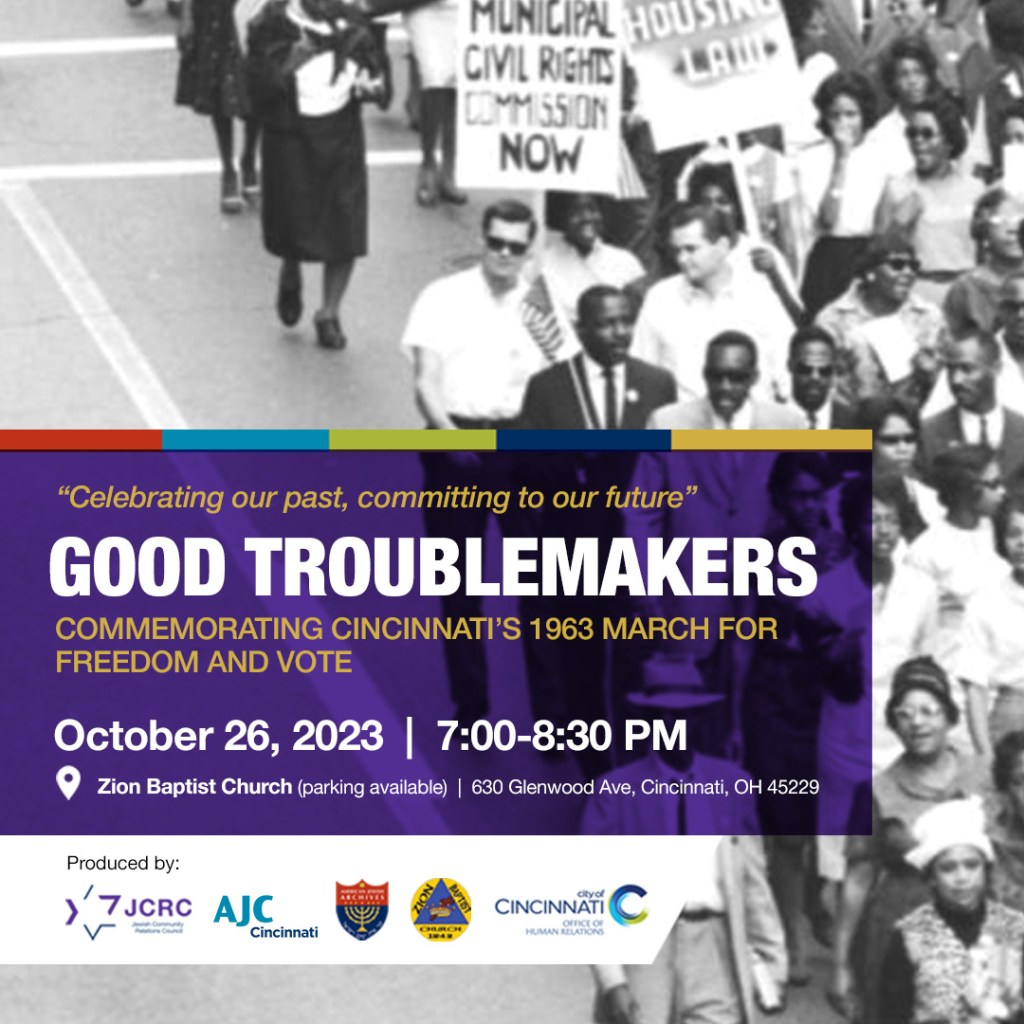
This is some of the historical landscape of the Cincinnati forged a century before the August 28, 1963 March on Washington for Jobs and Freedom dawned. The civil rights movement and this groundbreaking event inspired social change movements around the world. 497 Cincinnatians traveled on Tuesday August 27, 1963 by Chesapeake & Ohio Railway from Cincinnati Union Terminal to the District’s Union Station for $20 round trip.
The conditions were ripe in Cincinnati that, upon their return, local leaders organized an October 27, 1963 Freedom March to Fountain Square, inspired by Otis Moss who had in turn been moved by Martin Luther King Jr. It may be conceivable that no one exists who has not heard of the March on Washington. While I am a transplant to Cincinnati from Chicago, I never heard of the Cincinnati march or if organizing marches back home may have been an embedded strategy obscured by the magnitude of the DC event. The continued local momentum, replicated in a march, appears to be a Cincinnati idiosyncrasy.
Unique Cincinnati history abounds. I was at the New York Transit Museum when I learned of Granville T. Woods (born in Columbus Ohio and lived for a time in Cincinnati) who engineered technology a century ago that revolutionized the subway. It was in reading Stamped from the Beginning: The Definitive History of Racist Ideas in America by Ibram X. Kendi where I heard about Charlene Mitchell (born in Cincinnati), the first black woman to run for President of the United States of America in 1968 as a member of the Communist Party. The internet taught me that Alice King Chatham, a Dayton Ohio sculptor, helped create the earliest helmets for astronauts of the space program. Josiah Henson stayed in Cincinnati for just a few days, but while here influenced Harriet Beecher Stowe’s writing of Uncle Tom’s Cabin. Just two weeks ago, I learned that Michael W. Twitty lived in Cincinnati when he was young. Our city has claimed things with less intersections. Why are these things I did not know as a resident of such an old city? I look forward to hearing from people who attended both of the 1963 marches and learning more about this proud Cincinnati history.
The event is free, open to the public, and does not require advance registration. Join us between 7-8:30pm on Thursday October 26, 2023 at Zion Baptist Church located at 630 Glenwood Avenue, Cincinnati, Ohio 45229.
“That day, for a moment, it almost seemed that we stood on a height, and could see our inheritance; perhaps we could make the kingdom real; perhaps the beloved community would not forever remain the dream one dreamed in agony.” -James Baldwin






 Jews of Color Sanctuary