Join scholar-in-residence, erica riddick, in Newton Massachusetts June 13-15 for three interactive sessions:
• FRIDAY JUNE 13: 6:30pm maariv service dvar Learning From Enslavement: Tapping Into a Foundational Message of the Torah & 7:30 dinner conversation at Temple Shalom; register for this conversation provoking dinner
• SATURDAY JUNE 14: 9:45-11:15am Juneteenth, July, & Freedom text study at Temple Shalom
erica will share their personal journey of how Bilhah and Zilpah has enriched connection to the Torah and engagement with challenging texts. Sessions will connect biblical enslavement with historic and modern manifestations, including emergent immigrant transgressions, as both source and opportunity, to live our values.
This scholar-in-residence opportunity will synthesize years of study on how Bilhah and Zilpah can bring awareness to social justice imbalance, how we can honor Bilhah and Zilpah as Jewish matriarchs, and ways to bring their wisdom into our action and ritual.
The night sky has always been miraculous. Even before humanity came to understand the impact of the moon on earth’s seas, it is easy to understand how calendars began marking lunar time. While the location of the sun came to reveal the time of day, and the trajectory height of the sun’s path associated with the seasons, the moon’s changes in visibility governed cycles into months.
Thinking of the moon commonly conjures images of white fullness against a sea of black, a sphere of peace amid the תֹ֙הוּ֙ וָבֹ֔הוּ וְחֹ֖שֶׁךְ tohu v’vohu chaos and void (Genesis 1:2) of seeming endless blackness. Yet the Jewish holiday of Rosh Chodesh celebrates the arrival of a new Hebrew month with the birth of every new moon. Setting the month in the darkness of the new moon may follow the wisdom seeded within the Torah’s story of creation spanning from evening to evening, וַֽיְהִי־עֶ֥רֶב וַֽיְהִי־בֹ֖קֶר vayahi erev vayahi boker there was setting there was dawning (Genesis 1:5).
God calls for light and it appears. God proclaims the light good, makes distinct within the dark, naming light day and dark night. This binary separation and naming originating through the first day of creation (Genesis 1:4-5) repeats in the separation of the water of the heavens from the water of the seas (Genesis 1:6-8), sea from the first place of dry land (Genesis 1:9-10), and adding lanterns to further mark night and day (Genesis 1:14-18). Genesis 1:16 opens with God creating two great luminaries before immediately suggesting the larger light rule the day and the smaller rule the night.
As the story of creation continues, God brings forth grass, seeds, fruit trees, sun, moon, stars, water creepers, flying birds, sea monsters, herd animals, land animals, and humans (Genesis 1:2-27). Each introduction affected what was surrounding it.
All water on earth is connect to the seas. All water is affected by the gravitational pull of the moon. Yet, noticeable effects are increased or diminished by volume.
In Chullin 60b:2-4, Rabbi Shimon ben Pazi notes the contradiction between equality and what appears to be an immediate shift. Pazi shares midrash outlining an exchange between moon and God. It’s easy to wonder about the moon’s motives in questioning, and blame the lessening as a repercussion of confronting God. Making an analogy to the doctrine of separate but equal can offer another perspective of the moon as a body of light willing to speak up and call out separation presented as equal that is not.
There is more to be curious about in these lines––referencing kings (masculine plural) and speaking ‘to her’ in an equality framework, God’s ability to call forth creation and separation through words yet directing moon to diminish itself, humans bringing sacrifice to atone for a transgression of God, the stars being luminarily ignored, and linguistic associations with great-lesser and light-dark, for example. Amidst the questions, a beautiful aspect of this midrash is that God listens to moon, and continues to try to make reparations. In the culminating attempt, God notices moon is not comforted. God acknowledges the harm, attempts to make amends, and pays attention to the result.
This story could be minimized as cleaning up one’s mistake. This moment can also be read as allyship. Intentional, careless, and unconscious harm are distinct states. Making mistakes is inevitable and can happen through carelessness or unconsciously. How we respond is what matters most. We are theanthropic bodies affected by and affecting the world around us. This midrash invites us to pay attention when questions are raised, consider actions, and pay attention that an intention of solution lands as such. There’s also an unspoken message of mutual responsibility. Moon braves speaking up and God braves making repair. Along the way, both brave listening to the other.
Jews of Color Sanctuary partnership with Mayyim Hayyim entered its third year with the opening of Let Justice Well Up, a text study for Jewish women and nonbinary folks of color. This year we will explore our connection with the moon that moves tides, orders our Jewish calendar, and invites celebration of Shekhina, the female-centered aspect of the divine. Let the monthly blessing of Rosh Chodesh, birth of the new moon, wash over you through Jewish and secular texts welcoming us into ancient ritual and tradition to nourish our lives, creative practice, and personal ritual.
Register to join this affinity space for Jewish women and nonbinary folks of color on fourth Sundays through July between 9-10:30amPT / 12-1:30pmET / 6-7:30pmWAT / 7-8:30pmIT. Cost is self-determined sliding scale $36-$118. If cost is a barrier, please contact Soreh Ruffman at sorehr@mayyimhayyim.org.
Guest blog by Christine Ngeo Katzman, Jewish Federation of Cincinnati
I’m Chinese-American, and my husband is Caucasian. A long time ago, we chose to raise our children Jewish. We have blended our cultures, celebrating three different New Year’s holidays, for example: the Jewish New Year of Rosh Hashanah in the fall, the Gregorian New Year on January 1, and Chinese New Year later in the winter. I have loved having three opportunities to start over. We also celebrate Christmas and Easter in secular ways.
In 2016, when my oldest daughter was 12, she announced an interesting idea: “Let’s invite all of our Jewish friends to come over for Chinese food on Christmas.”
At first, I laughed and dismissed it. But the more I thought about it, the more I realized that the concept was brilliant. After all, we didn’t have any plans to travel or host out-of-town family that year, and some Jews have a tradition of eating out at a Chinese restaurant for Christmas anyway. So, I agreed to her idea on one condition—that she help me cook.
She happily accepted, so we planned the menu as a family, bought all the necessary ingredients at the Asian market, and worked together for hours on Christmas afternoon to chop vegetables, marinate meat, and take turns stir frying as well as literally frying over the hot stove. My husband and younger daughter participated too.
We served lo mein, beef and broccoli, pot stickers, lumpia—Filipino spring rolls—as well as latkes. Lumpia is a particularly time-consuming but an important holiday food in our family. I am Chinese, but my parents grew up in the Philippines (also where I was born). And for dessert, one of our friends brought homemade sufganiyot (jelly donuts); we also served pie.
That year, the second night of Hanukkah fell on Christmas, making the evening even more special for all of us. Two additional families attended our Chrismukkah, and each family brought a Hanukkiah to light. Our bellies were full, the light shone bright, and we celebrated friendships and family.
We replicated this event one more time in 2018 and also included my sister, who was visiting from another state. Ironically, that day, we played the board game Pandemic together.
In 2022, I met Erica Riddick, founder of Jews of Color Sanctuary in Cincinnati. I had just recently changed careers and joined the Jewish Federation of Cincinnati as a Community Building Associate. Although we first met in passing at the JPro conference in May, Erica contacted me again in September to get to know each other better.
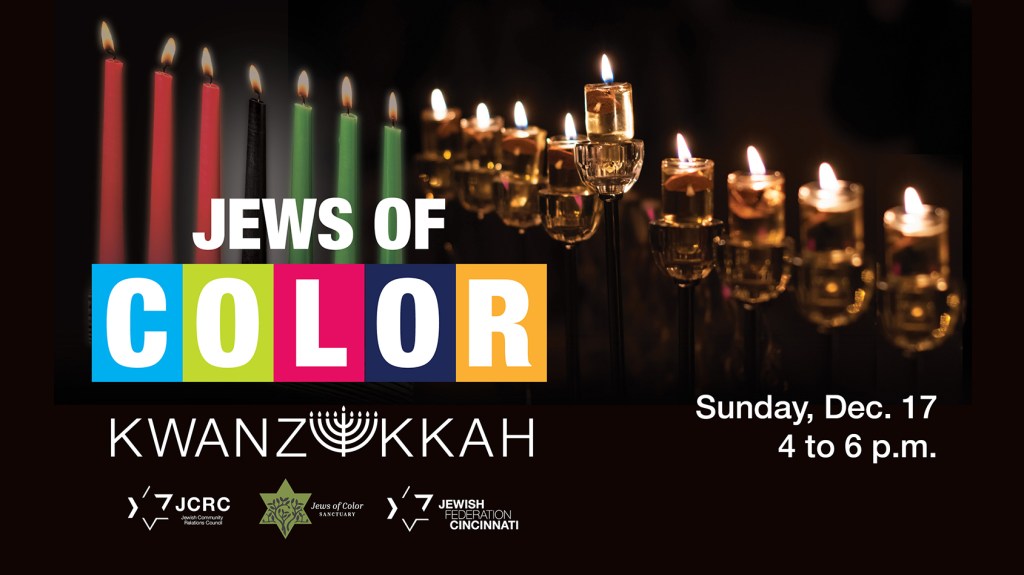
While I never thought of myself as a Jew of Color, the incidents of Asian Hate during the COVID-19 pandemic made me realize that minorities need to be allies with each other. During my meeting with Erica, I reminisced about my Chrismukkahs past and mused about how cool it would be to celebrate Christmas, Hanukkah, and Kwanza together. Here we are now, bringing that idea to life together in 2023.
On December 17, I look forward to gathering with other Jews of Color to learn more about each other’s cultures as we combine for a wonderful Kwanzukkah event (which will include some Asian food as well), co-sponsored by the Jewish Community Relations Council, Jews of Color Sanctuary, and the Jewish Federation of Cincinnati. In this very difficult fall for Israel and for Jews around the world, I hope that these holidays filled with joy and light will bring us closer together.
I have long been a fan of mussar as a Jewish spiritual practice that can help us strive to be better versions of ourselves through concentrated reflection and practice. Like in the ways we practice math, life, or Judaism. We like to say practice makes perfect, but it really makes better.
That first mussar group for me was in Cincinnati at Lloyd House organized by a beloved ally. I loved it AND there were also moments when it was clear that my experiences as the lone black participant were just too far removed for the rest of the group to really be able to hear. Fast forward several years to Israel where my studies led me to a deeper connection to Chasidut, not as something that others did, but aspects of my own practice which had always been there. Skip ahead a year to my first mussar group in an all-black Jewish setting… life changing!
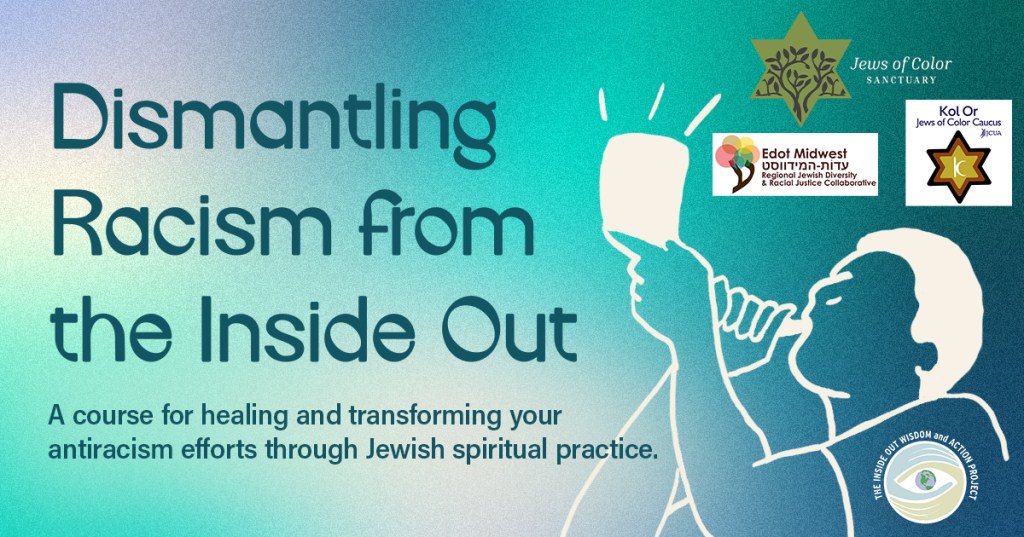
That mussar group was facilitated for the Black Jewish Liberation Collective by Dismantling Racism from the Inside Out (IOWA), a project of Inside Out Wisdom & Action (DRIO). While a personal practice, mussar benefits from group support elements that fulfill a witness and accountability partnership role which feels important to me. This was the element that had been missing in my first mussar experience. Falling in love with mussar through my first experience despite lacking community support testifies to the power of this practice. Finding community made mussar even more magical.
It is with this deep personal knowing that I am proud to announce that Jews of Color Sanctuary is partnering with Edot and Kol Or (the Jews of Color (JoC) Caucus of Jewish Council on Urban Affairs (JCUA)) in offering an affinity space DRIO Midwest PoC Cohort that will start November 7, 2023. This course is intended to build on an existing antiracism foundation–this is not an antiracism 101 course. This will be a unique and important opportunity to build relationships and infrastructure among Midwest Jewish people of color communities which often doesn’t happen with the value bias that keeps focus and resources in coastal Jewish communities.
As our thoughts and preparation shift toward 5784 acknowledgement of collective sins and our community need to address wrongs and work towards building the world of tomorrow today, I invite you to join us. There is no better way to bridge the concepts of betzelem Elohim, tikkun olam, and not standing idly by than honing the ancient Jewish wisdom of mussar in service of our anti-racist work. The words of a past participant speaks to the power of this program better than anything else.
Allies too can support this project in a variety of ways. JoC friends and family always need your kindness and loving support especially while one is actively engaged in dismantling internal racialized systems of oppression. Ask how the va’ad is going, plan regular check-ins, share your own anti-racist journey reflections. And, if you have the ability, you can contribute financially to the materials and facilitator fees, through the cohort registration portal, which will make the accessible sliding scale of this va’ad possible.
I’m excited to share a ground-breaking research project to learn how Jewish people of color (JoC) engage with Jewish end-of-life rituals and practices. Ultimately, this information will inform the creation of resources most needed and desired to support Jews through this time.
I invite you to share the survey with your networks using sample language and social media formatted images in our Media Kit to help facilitate sharing.
Thank you for supporting and reflecting the diversity of the #JewishCommunity.
The universal human relationship with water is revered in many cultures for connection, purification, cleansing, transition & wisdom. During ritual immersions, physical barriers are removed between our body and the water. This series is a moment for attendees to remove mental or spiritual barriers from past experiences and deepen their relationship with Judaism and this ancient tradition. The communities where guides live can continue to support removing barriers as you welcome and celebrate these “mikveh guides as wisdom-holders and educators” attracted to this learning because they are already vibrant participants in their Jewish communities.
Program design development and implementation planning was a big job. For this community that means the world to me, it was important to create a space where every individual could bring the full-fabulousness of their beautiful selves completely into the space and learn from the course, each other, and themselves. It was worth it to read feedback confirming that 100% of participants felt a sense of belonging, 100% would recommend the program to a friend, and 92% learned something new. What I didn’t expect was how much this work for others would also feed my soul. I had the opportunity to create an opening ritual and prayer which feels bigger than the specific moment it was created for. May its words nourish our souls in ritual moments we need to hold us…
May we remember that the waters of Gan Eden still flow through our bodies and the earth,
the four rivers of Pishon, Gihon, Hidekel, and Perat.
May we allow those ancient waters to connect us to our ancestors and our first home,
lands of gold and precious resource, lands of Ethiopia, lands of Assyria.
May we use our knowledge to protect the source and follow the water to life,
with gratitude for the waters that hold us and the heavens that give us breath.
I am a self proclaimed word nerd who loves lexicon and has a dictionary in every room. How language evolves over time and where words and expressions come from is fascinating, especially when shifting context results in differences between modern over original usage.
Commemorating the destruction of the temple, always makes me think of the phrase the body is a temple. I never knew the phrase’s origin, but like the spiritual imagery that aligns with my ideologies of feeding body and soul and getting out what you put in. While a quick search attributes the phrasing to Christian liturgy, Judaism also expresses honoring the body in many ways. Notably, in expressing daily gratitude for the functions of our body and allowing breaking halacha in order to preserve life. So, during Tisha B’Av, my mourning extends to the destruction of black bodies, which feels like a paradox of prayers like Elohai Neshama and the poetry of Psalm 139.
Yet, there is a lot of beauty in the modern Judaism born from the ashes of the temple, decentralized into each of our families and transferring the holy of holies into our hearts, like a turtle, who is never without it’s home. Turtles are evoked whenever I see a child hide under their mother’s skirts or inside their own blanket. I hold this ability to go into my own turtle house when and where, ever I need to. I want to acknowledge and love the broken parts of myself, whether physical, mental, spiritual or a combination of all three. To somehow transition from destruction as damage, different from deconstruction. Re-turning shards in-to a mosaic of beauty.
The idea of mourning AND celebrating is familiar in how funerals can be joyful in their reunion among the living as we mourn the dead. On this Tisha B’Av, after the fires ignited from the destruction of black bodies across the United States of America, the mingling of mourning and joy is poignant. Jews dream of rebuilding the temple, but what if each of us were the stones, simultaneously unique yet interdependent with every other stone, in different but important ways? What if the temple we rebuilt was the world?
I know this may come across as terribly naïve, ignorant of history and completely impossible… but what if it’s not? What if it’s as easy as a decision? Maybe the hard part is choosing to do it every day. As prayer can feel like a chore that detracts from more important things for some and for others is habit from repetition, the work of building the temple is not done when construction is complete. Building maintenance is a lifelong necessity, that, by habit, can be normal, easy and regular, but if ignored and resisted, one day becomes a crisis, potentially a critical collapse.
Architecture feels an apt language for considering the relevance today of the destruction of 2 temples yesterday, but Torah wants us to explore whatever analogy resonates within, that honors our uniqueness and interdependence. Find your voice and your light and share it with the world. Today, we mourn not only the destruction of the temple, but say goodbye to civil justice icon John Lewis, who could have understandably focused on living out his life, but chose to offer one last bit of Torah through the words of Martin Luther King Jr, that “we are all complicit when we tolerate injustice” and in John’s own words, that “ordinary people with extraordinary vision can redeem the soul of America” and “answers worked out long ago can help you find solutions”.
The phrase “I can’t breathe” has come to mean more than it’s words, perhaps because Elohai Neshama reminds us that our soul and breath are united. May we redeem the soul of America through the breath of our unique voice, flowing from the temple of humanity to God and back again, breathing as one.
I spent the first few weeks of my COVID-19 mass layoff trying to file for unemployment, reset my PIN, reach a human without the call disconnecting me, write letters to Directors, Governors & Senators to clarify confusing unemployment language around eligibility after missing the noted filing deadline, while cleaning up, researching and installing a new water heater because, what’s one more crisis. I’m glad people are finding creative ways to create community in these quarantined days of coronavirus 2020. I’ve needed the phone calls and texts offering empathetic ears.
I’m in between poor and rich. I live simply and frugally. Monthly internet is not in my budget. The little I used it, before, was in my office after work. Being sent home after the mass layoff, effectively disconnected me, although I’m grateful to have a key and can still use internet occasionally, unlike those who relied on libraries, now closed.
I explored getting basic internet in the hope my old computer would allow video conference connection, and learned “affordable” = $50 per month and may not include wifi, which would allow Zoom by phone without breaking data caps. $100 a month is not unusual.
These expenses add up. For families, the cost per person may not seem bad, but for an individual, it feels prohibitive. Even now, when I really want to Zoom. Does this qualify as a need? Humans struggle to ask for help, and it’s difficult when you know people are much much worse off. Some are dying. But, does that mean I shouldn’t want more?
In the growing conversations around wealth distribution, I wonder how the idiosyncrasies between income and wealth affect how decisions like internet affordability, affect disproportionately. Who can continue to work. Go to school. Register for unemployment. Get information. Have companionship that includes body language and tone of voice that make up the bulk and nuance of communication in the absence of in person gatherings.
Many are saying things will never be the same. In some ways, I hope they won’t be. I want the exposed issues with assistance we thought was there for people who need it and work environments with lipservice of not going to work sick but knowing you better show up no matter what, become conversations we have. If we relish the idea of greater electronic connection, it doesn’t necessarily have to be a bad thing, but will we choose to find ways to build infrastructure that doesn’t leave people out and also doesn’t force people to forfeit their freedoms to opt in.
The joke this year is that Elijah won’t be coming to uphold social distancing. However, Elijah will be the only person at my seder. I just hope I don’t have to wait all night for their arrival. I love the concept of inviting Elijah, despite the conflict of opening the door at the end of the meal. I’ve taken to inviting Elijah to every gathering. What does it truly take to invite the stranger into one’s home? We think of strangers as people far from us, but sometimes it seems like strangers can be close, maybe even people we think we already know.
Tonight, conversation around moving from slavery to freedom, or the illusion of the abolition of slavery, is definitely going to be different this year. While my seder will ask the questions to myself, I pray, when we can leave our homes, maybe even before, we can have these conversations in ways that don’t pit ism’s against each other, includes us all and where creating an equitable world feels worth it and not like losing. And I pray, we don’t become permanently afraid to touch one another. I am going to need a good long strong hug when this is over.
When I was a child, I was always creating. Somewhere, on the way to adulthood, despite going into a creative profession, I left the devising ritual and imbuing meaning to other professionals. While I was taught to think and to question, that was only supposed to go so far before turning to an expert. It sounds strange to say, but I now realize I am the expert of myself and my life and in choosing what moments I want to create ritual and highlight meaning around.
Reading Inventing Jewish Ritual by Vanessa L. Ochs came at the perfect time and helped hone the ritual innovator inside me to more confidently claim ownership over my prayers and new rituals in a subtly different, but deeply profound way. Prayer had always felt meaningful and personal to me, but Ochs’ historical foundation framing of Jewish ritual development created space for me to bring a fuller authentic self to current rituals and helped me to bravely create rituals rooted in Jewish practice for important life moments I want to mark or honor.
I feel there are many lost opportunities to help Jews of Color see themselves through the people of Color in the Torah. One of the foundational reasons I created this forum is to offer a safe space, a sanctuary, for Jews of Color in the Cincinnati and surrounding areas to explore those topics among other Jews of Color craving similar opportunities for chevruta, study and exploration. Our March event topic was Celebrating JOC Ritual and beyond texts pulled from Creating Jewish Ritual, we used one of my favorite texts borrowed from a friend’s article titled Bagels, Lox, and Grits: Defining My Jewish Identity by Yolanda Savage-Narva.
One of the food elements I connect with Rosh Hashanah is black eyed peas, after reading this was a popular African dish to celebrate the Gregorian New Year. This afternoon, I was part of a program that happened in an art studio. I learned a new kiln was being fired for the first time. As as artist who has mourned the loss of pieces which didn’t make it through firing, I immediately offered a simple prayer for a vessel which will bring beauty into the world. Daily minyans and Shabbat are crucial for me, but acknowledging the relevance of art is important to me too. Bringing aspects of myself in that I sometimes feel are pushed aside helps me step into a fullness of myself and my power that is exactly what I believe God wants for me. In the end, the ritual nuances that bring me the most joy are often simple elements. How they find their place is not always easy, but it always feels worth it.





 Jews of Color Sanctuary