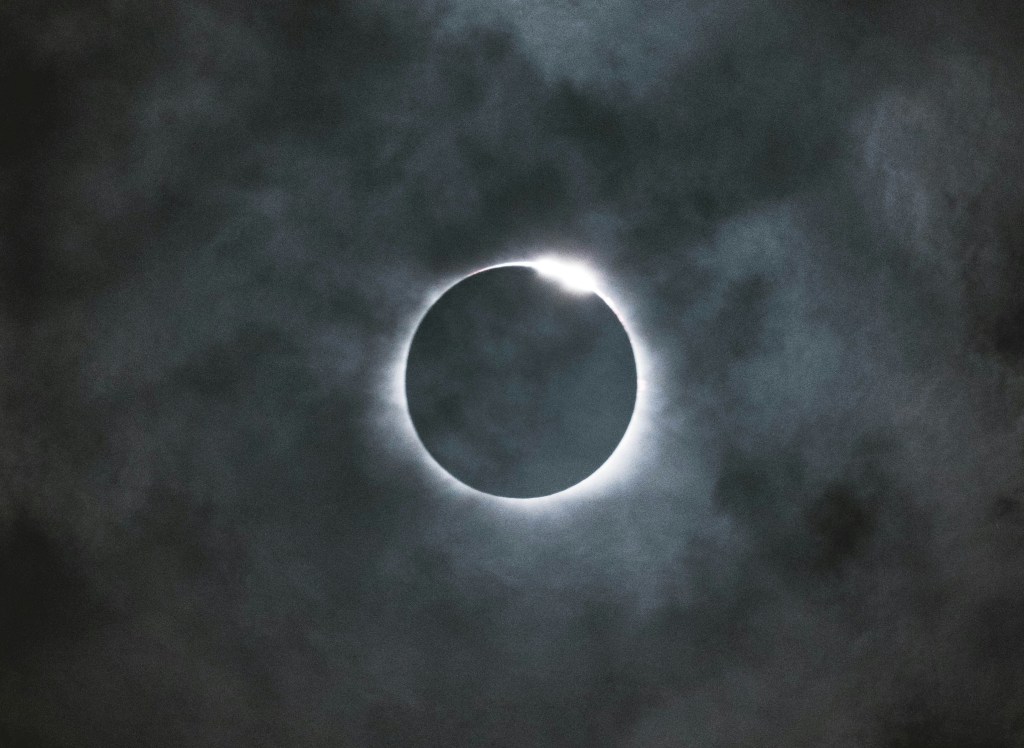
The night sky has always been miraculous. Even before humanity came to understand the impact of the moon on earth’s seas, it is easy to understand how calendars began marking lunar time. While the location of the sun came to reveal the time of day, and the trajectory height of the sun’s path associated with the seasons, the moon’s changes in visibility governed cycles into months.
Thinking of the moon commonly conjures images of white fullness against a sea of black, a sphere of peace amid the תֹ֙הוּ֙ וָבֹ֔הוּ וְחֹ֖שֶׁךְ tohu v’vohu chaos and void (Genesis 1:2) of seeming endless blackness. Yet the Jewish holiday of Rosh Chodesh celebrates the arrival of a new Hebrew month with the birth of every new moon. Setting the month in the darkness of the new moon may follow the wisdom seeded within the Torah’s story of creation spanning from evening to evening, וַֽיְהִי־עֶ֥רֶב וַֽיְהִי־בֹ֖קֶר vayahi erev vayahi boker there was setting there was dawning (Genesis 1:5).
God calls for light and it appears. God proclaims the light good, makes distinct within the dark, naming light day and dark night. This binary separation and naming originating through the first day of creation (Genesis 1:4-5) repeats in the separation of the water of the heavens from the water of the seas (Genesis 1:6-8), sea from the first place of dry land (Genesis 1:9-10), and adding lanterns to further mark night and day (Genesis 1:14-18). Genesis 1:16 opens with God creating two great luminaries before immediately suggesting the larger light rule the day and the smaller rule the night.
As the story of creation continues, God brings forth grass, seeds, fruit trees, sun, moon, stars, water creepers, flying birds, sea monsters, herd animals, land animals, and humans (Genesis 1:2-27). Each introduction affected what was surrounding it.
All water on earth is connect to the seas. All water is affected by the gravitational pull of the moon. Yet, noticeable effects are increased or diminished by volume.
In Chullin 60b:2-4, Rabbi Shimon ben Pazi notes the contradiction between equality and what appears to be an immediate shift. Pazi shares midrash outlining an exchange between moon and God. It’s easy to wonder about the moon’s motives in questioning, and blame the lessening as a repercussion of confronting God. Making an analogy to the doctrine of separate but equal can offer another perspective of the moon as a body of light willing to speak up and call out separation presented as equal that is not.
There is more to be curious about in these lines––referencing kings (masculine plural) and speaking ‘to her’ in an equality framework, God’s ability to call forth creation and separation through words yet directing moon to diminish itself, humans bringing sacrifice to atone for a transgression of God, the stars being luminarily ignored, and linguistic associations with great-lesser and light-dark, for example. Amidst the questions, a beautiful aspect of this midrash is that God listens to moon, and continues to try to make reparations. In the culminating attempt, God notices moon is not comforted. God acknowledges the harm, attempts to make amends, and pays attention to the result.
This story could be minimized as cleaning up one’s mistake. This moment can also be read as allyship. Intentional, careless, and unconscious harm are distinct states. Making mistakes is inevitable and can happen through carelessness or unconsciously. How we respond is what matters most. We are theanthropic bodies affected by and affecting the world around us. This midrash invites us to pay attention when questions are raised, consider actions, and pay attention that an intention of solution lands as such. There’s also an unspoken message of mutual responsibility. Moon braves speaking up and God braves making repair. Along the way, both brave listening to the other.
Chodesh Tov Adar


 Jews of Color Sanctuary