Sigd, a day of return

Hirut Yosef

Friday evening is erev Sigd; 29 Cheshvan 5785 in the Jewish calendar begining on November 29 in the 2024 Gregorian calendar. This holiday, preserved in the Beta Israel (Ethiopian Jewish) tradition, became a national Israeli holiday in 2008. Despite celebrating many Israeli holidays in the United States of America, Sigd was not among them. I learned of Sigd as my insistence on bringing my full self into my Judaism grew beyond the confines of Ashkenormative settings with too many moments conveying that I am not enough. Sigd was one small way to hold my Jewishness with threads towards other cultural identities, including an African-ness historically severed from everyday familial consciousness, like many affected by the transatlantic slave trade.

So, when Jews of Color Sanctuary launched in 2019, it happened during a small community event celebrating Sigd. The following year I was living in Israel and excited to celebrate Sigd again. The large gathering typically planned for the Tayelet promenade overlooking Jerusalem was affected by the coronavirus pandemic. It was challenging to find revised events as a visitor who is not a member of the Beta Israel community. I thought all of Israel would be celebrating, but found no outward signs. If you didn’t know it was Sigd, you wouldn’t know it was a holiday. Asking folks at my yeshiva revealed a belief that the holiday was cancelled. I was shocked because we had just gone through the high holy days which were changed, but not cancelled. I had even heard many stories of events like weddings, b-mitzvot, brit milot still happening. Why was it easy to believe that Sigd would just be skipped?

I thought of how some are happy to have a Martin Luther King Day off of work but don’t hold any part of the day in observance. Sigd appeared to be a national holiday in name with more to the story. Researching for the Jews of Color Sanctuary launch revealed a desire of Beta Israelim for all Jews to celebrate Sigd. I sensed a pride in having preserved this history for Judaism. That invitation made me feel brave in my previous observance. Now, far away from home, when I thought I would attend events out of many scheduled throughout Israel, I couldn’t find one. I was heartbroken and angry.

I took the day off of school and dedicated myself to figuring out something! Before traveling to Israel, I had found a North American Beta Israel organization. Through those attempts to connect with Jewish people of color in Israel before I arrived, I met a person who invited me into celebration and later became a friend. As with many things in life, despite the tragedy in the moment, I am grateful for gifts acquired through the journey.

I think of Sigd as a holiday of return. During Rosh Hashanah this year, I thought a lot about where I am returning to? More and more, my sense of return is less about a physical journey than an internal one, something I may spend a lifetime figuring out. In thinking about all of the things that had to come together to make me into the person I am today and bring me to the moment and place where I am at this very moment, gives me a lot of gratitude about the interrelationship between things. Without the events that caused my parents to meet, I would not be here. My reaching for Sigd as a way to hold my full self within Judaism happened along a trajectory that continues to reveal itself… or maybe, is my path of return. I am grateful that I have company along the way as I continue to figure it out.

I invite you to join me. One exciting opportunity is the Bilhah Zilpah Homecoming this Sunday December 1. We will prepare to welcome Bilhah and Zilpah for their return to the Torah during parashat Vayeitzei (and a little celebration of Sigd / JoC Sanctuary anniversary). Bilhah and Zilpah offer a rich lens to explore biblical experiences that remain a reality today, such as surviving marginalization, being in sisterhood, and striving towards abolition.

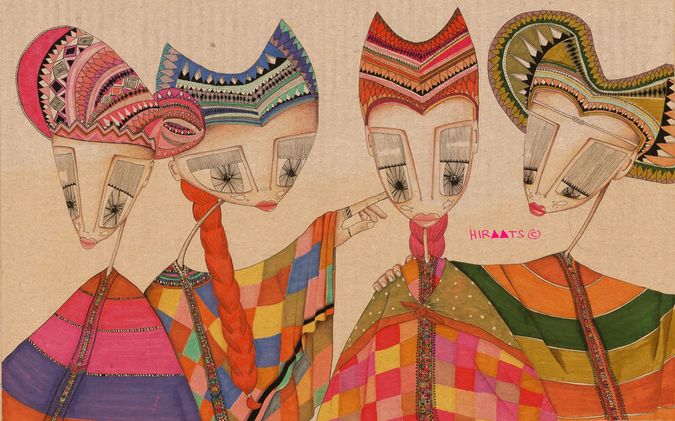
Wishing you a meaningful Sigd with engaged learning about the holiday and the Beta Israel. The image opening this post is by Hirut Yosef who emigrated from Ethiopia to Israel and has also lived in Turkey, the USA, and elsewhere. Hirut uses her art to explore the relationship between Ethiopia, Israel, and other places she has lived, as well as return in a variety of ways. May your return take you where you need to be.

Shabbat Shalom v’Chag Sigd Sameakh
JoC Journey Toward Healing

guest blog by Tamar Ghidalia & Jill Housen, 3W Consulting

3W Consulting‘s work is anti racist and anti-oppression work and uses liberatory practice at its core. Since the work is significantly grounded in Jewish life, tradition, texts and values, it enriches the spiritual life of the participants and allows them to claim their Jewish identities.

We have served 20 organizations over the last 3 years: congregations, communal organizations, schools,camps, and presented at national conferences. We intentionally support and center JoC’ leadership.

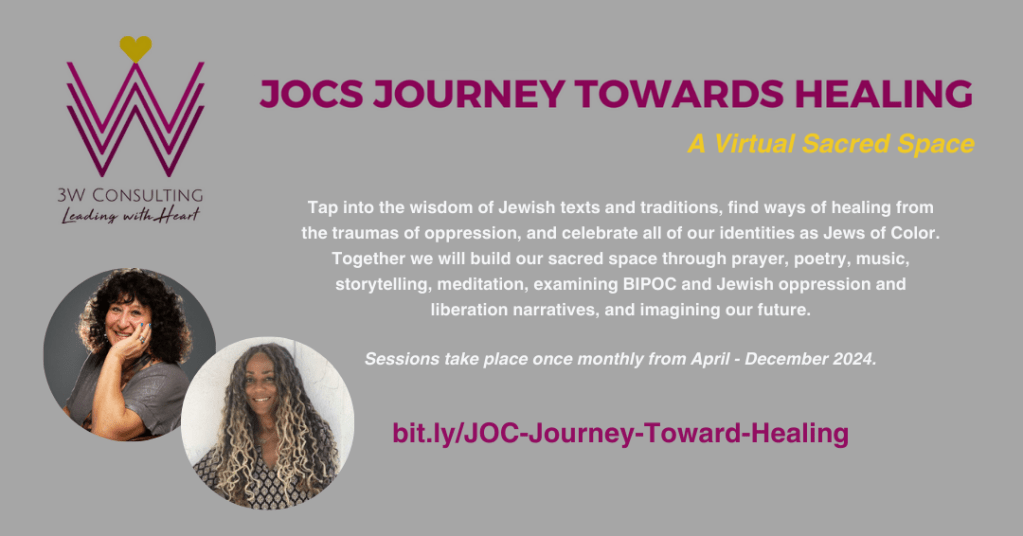
We created JoC Journey Toward Healing because of the need of JoC to have places to just be and share their identities in a safe space. We believe that JoC are deserving of care and joy, feeling seen, heard and understood, feeling empowered and not alone…

By tapping into the wisdom of Jewish tradition and texts, we can find ways of healing from the traumas that we have faced and be able to bring forth all of our identities. Together we can build our sacred space through prayer, poetry, music, storytelling, meditation, comparing the BIPOC and Jewish oppression and liberation narratives, and sharing our dreams of liberation.

Please register to join us.

Best,

Tamar & Jill

Gregorian year in review

Jews of Color (JoC) Sanctuary was born on Sigd in November 2019. The date was a nascent expression to bring Jewish reflections from communities of color into deeper relationship with a vision to create a sanctuary for Jewish people of color in Cincinnati and the Midwest. Like all things in development, the idea of JoC Sanctuary had been brewing for many years before emerging. April Baskin and the 2018 JewV’Nation cohort were particularly supportive in fostering early dreaming of Midwestern JoC space. We have grown slowly over the last four years of infancy and 2023 has been an exciting year of growth as we enter toddlerhood.

We were awarded our first formal grant through ArtsWave, made possible through our fiscal sponsor, ish Cincinnati. JoC Ritual Studio was an invitation to claim our right to Jewish ritual that reflects the fullness of who we are and offers meaningful marking of important transitions. JoC Sanctuary was a featured speaker at the Rising Tide Conference and supported facilitation of a Seven Steps Mikveh Guide Training, including original ritual creation (a new cohort starts in February!^). We learned and taught Dismantling Racism from the Inside Out (DRIO).

Other community interactions include, returning to the Jews of Color Mishpacha Project Shabbaton, deepening connection through creative practice skills, standing in solidarity with refugees, celebrating the rich diversity of faiths, getting up to some good trouble, bringing light into the world, and shepherding Jewish End-of-Life Practices & Rituals research which will be released in 2024.

We co-sponsored events with the Jewish Community Relations Council and the Jewish Federation of Cincinnati. We collaborated with Birds of a Feather, Black Jewish Liberation Collective, ish Cincinnati, Jewish Community Library, Jewish Spiritual Leadership Convening, Jewish Women’s Archive, Kirva, Mayyim Hayyim, and Rising Tide. We were supported by ArtsWave, Jewish Bridge Project, in-kind contributions, and individual donations.

This year has welcomed the Bilhah Zilpah Project and Parasha Play as special projects of JoC Sanctuary. Parasha Play is an improv-based Torah exploration and the Bilhah Zilpah Project seeks to reclaim these Jewish matriarchs, and listen for the wisdom that their silenced voices can teach us into our modern lives. 2023 closed with the inaugural launching of the Bilhah Zilpah Project through a series of homecoming events. Parashat Vayeitzei falls shortly after Sigd every year, sweetening welcoming this project as a poetic return to our beginning.

Sincere gratitude goes out to all the individuals and organizations who have fostered the growth of Jews of Color Sanctuary through participation and co-creation. We look forward to continuing creating sanctuary in 2024. If you have skills you would like to share with us, please email danserica@gmail.com and if you would like to provide financial support, contribute through our fiscal sponsor’s webpage: noting the funds are for Jews of Color Sanctuary.

Joyful Gregorian New Year celebrations for continued sweetness in your Jewish year!

Kwanzukkah Reflections

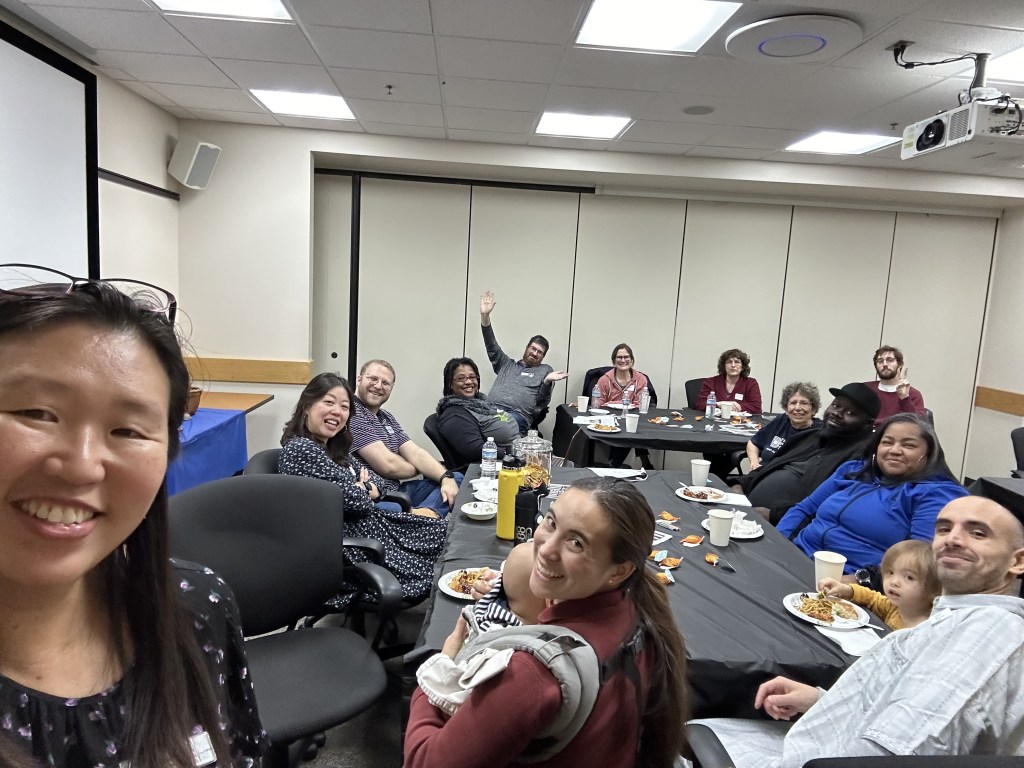
Kwanzukkah attendees pose for a mid-celebration photograph (photo by Christine Ngeo Katzman)

Sixteen people across a wide spectrum of ages and backgrounds came together to create a space where we can bring the fullness of our fabulous Jewish selves, including all of the messiness that makes us each who we are as individuals.

Kwaanzukka was an opportunity to bring all of the intersectional realities that people of color are never allowed to forget, but that is a reality of every life on this planet. Something evident in the rich conversation that ensued after bridging the land acknowledgment into an invitation to name the geographic places referenced at the event. From lands our ancestors originated, whether we had ever stepped foot on that land or not, to the cultural communities connected to the dishes we brought, whether those were our culture or not.

The responses were messy, full, and rich… from EVERY attendee. Affinity space is important. It is also important to have periodic open full-community events where Jewish people of color can show up in our fullness along with all of the people who love and support us, whatever their race or spiritual affiliation. To still center the voices and experiences of Jewish people of color and break down anti-blackness.

Jews of Color Sanctuary has done national virtual events which have been deeply meaningful for me. However, Kwanzukkah may be the only time I have ever felt like every part of me was welcome at an in-person event where I live. A simultaneously heart-breaking and exuberant statement. I lead this work because I need it in my life. I know it’s important because I see how powerful this work is in other settings across the country. Special thanks go to the JCRC and Federation for understanding the importance of creating events like this, and especially to each attendee… we created this space together and it could not have happened without you.

Jews of color… what kinds of events would be meaningful for your lives? Allies… please let the Jews of color you love know that JoC Sanctuary is their local resource and an opportunity to plug into the national networks of Jewish people of color from many backgrounds who are claiming their right to celebrate their Jewishness with the rest of their fabulous selves. We’re here for us.

Bilhah Zilpah Project – Vayeshev

One of the unique qualities in the source sheets for the Bilhah Zilpah Project is that they only include the Torah lines that reference Bilhah, Zilpah, or their children. As characters that have always been there, but whom often have to be introduced when brought into Torah study, this choice was an attempt to keep the focus on Bilhah and Zilpah.

Next Shabbat, we read Vayeshev, which contains a single line invoking Bilhah and Zilpah. Breishit 37:2 finishes the long accounting of the descendants of Yaakov that ends Vayishlakh. The line returns Bilhah and Zilpah to the status of wives.

The parasha is named for the opening line he dwelled. Bilhah and Zilpah dwelled as well. We learn that Yosef is seventeen. This can help us guess minimum ages for Bilhah and Zilpah. By now, these women have now dwelled through multiple stags of their lives and enslavement to reside as concubine matriarchs of one third of the twelve tribe namesakes.

The feud between Rachel and Leah lives on through Yaakov’s children even after Rachel’s death. Yosef is identified as being the favored son (of the favored wife). However, the line also suggests that Yosef worked alongside Bilhah and Zilpah’s children in specific tasks of tending the sheep. The negative reports could be of all of the brothers, but why mention Bilhah and Zilpah if not to indicate that the report defames Dan, Naphtali, Gad, and Asher? The children were named after all, not for hopes of their futures, but for how Rachel and Leah hoped their births would affect their relationship with Yaakov, even the children of Bilhah and Zilpah.

Despite the Torah laying out the intention that Bilhah and Zilpah’s children would belong to Rachel and Leah, Bilhah and Zilpah appear to have retained their status as mother. However, this line invites consideration for if their children were seen differently and for the legacy of how these children were named.

Reflection Questions:

• What do you notice in the begetting accounting, especially relative to Bilhah and Zilpah?

• How have the status of Bilhah and Zilpah changed over time?

• What clues do we have about the relationships Dan, Naphtali, Gad, and Asher had with their brothers?

Our homecoming continues with: Bilhah Zilpah Dreaming: Creative Play for Reclamation on Sunday December 3. You can also join us for the third and final event in this series: Bilhah & Zilpah Drew Near: Listening for Torah Women’s Wisdom on Sunday December 17.

Meanwhile, look out for our next Bilhah Zilpah Project email on Sunday December 10. And, if you missed it, check out the Vayishlakh and Vayeitzei reflections…

We see you Bilhah & Zilpah!