Shula Mola, November 5, 2026
Not long ago, I heard a story about why women carried stones up the mountain during Səgd, the Ethiopian Jewish holiday of renewing the covenant with God.
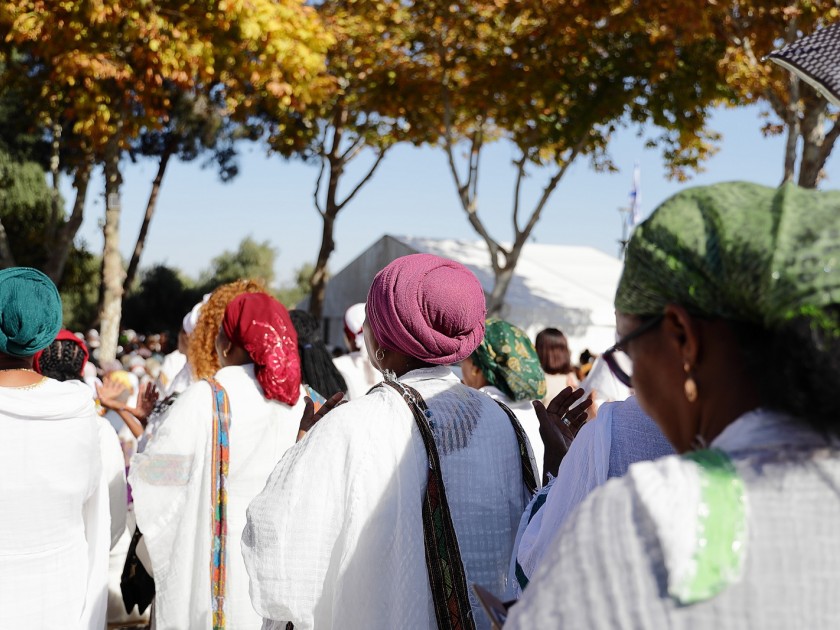
I grew up knowing that people carried stones as they climbed the mountain. Ethiopian Jews ascended dressed in white, having prepared through rituals of purification. The stones symbolized the sackcloth described in the books of Ezra and Nehemiah, expressing humility before God as part of collective repentance and renewal.
But the story I recently heard offered another meaning.
At the top of the mountain women would place their stones in piles. These piles, I was told, helped people recognize how many had come to celebrate Səgd. If there were fewer stones than the year before, questions followed.
What had happened?
Had drought struck a village? Had disease taken lives? Had families suffered hardship? Had some drifted away from Jewish life, or had a village abandoned its traditions?
Asking about the well-being of other villages was a familiar part of Səgd. People exchanged news, listened to accounts of hardship, and learned who needed material assistance or spiritual support. What was new to me was the suggestion that the stones themselves helped prompt those questions. I have been thinking about that story ever since.
The stones were not simply counted. They invited people to notice who was absent.
Səgd is often described as a holiday of longing for Jerusalem, a celebration of Ethiopian Jewish faith and perseverance. But it also carries a social message, that the well-being of an individual cannot be separated from that of the community. The question was not only whether I had fulfilled my religious obligations, but whether my neighbors could fulfill theirs, and whether someone needed help.
This year, that understanding of Səgd feels especially urgent.
Israel is experiencing profound internal divisions. Many Jews around the world feel increasingly isolated. Relations between Israel and parts of the international community have become strained. Disagreements about Israel, war, justice, and responsibility have sometimes made it difficult for Jews even to speak to one another.
What if, instead of asking only who stands with us, we began asking who is missing, who is hurting, and why?
I think of Haimanot Kassau, a nine-year-old Ethiopian-Israeli girl who disappeared from the grounds of an immigrant absorption center in Safed in February 2024. Nearly three years later, she is still missing. Her family continues to search for her and demand answers.
I have been involved in their struggle, and I wonder what it means for a society to continue caring when time passes and attention moves elsewhere.
If we were counting the stones today, would we notice hers was missing? Would we ask what happened? Would we keep asking until we had an answer?
Solidarity is not simply a feeling of togetherness. Nor does it mean defending everything done in the name of our community. Sometimes it requires confronting painful truths about ourselves. It demands attention, accountability, and action.
As a child in Ethiopia, I imagined the Land of Israel as a place where women, men, children, and elders lived together. No one pushed anyone aside. No one humiliated anyone. Everyone had a place. There was abundance, but no one took more than they needed.
That was the Jerusalem I carried with me long before I arrived in Israel.
I still think about that imagined place. Not because I expect a world without conflict, but because we need a moral vision against which to examine the world we have built.
Perhaps this is the gift Səgd offers us in 2026.
The covenant with God cannot be separated from our obligations to one another. If the stones teach us to notice those missing from our own community, they must also teach us to recognize the suffering of those beyond it. Otherwise, solidarity risks becoming another name for loyalty to ourselves. We live among other peoples, not above them or apart from humanity. Our future is bound to theirs.
The stones remind us to count differently: not to measure our strength by how many stand with us, but to notice who is absent, to ask why, and to take responsibility.
A covenant is not measured only by those who gather to renew it. It is also measured by what they do for those who cannot be there.
Shula Mola is an Ethiopian-Israeli scholar, educator, and human rights activist. Her research explores Ethiopian Jewish traditions, identity, and social inequality. She is a former Chairperson of the Association for Ethiopian Jews, co-founder of Mothers on Guard, and board member of the New Israel Fund. She currently teaches and conducts research at the Hebrew University of Jerusalem. This essay was originally published by Jewish Book Council. JBC enriches and educates the community through public programming, weekly reviews and essays, discussion questions, over twenty literary awards, and our Nu Reads book subscription series.

