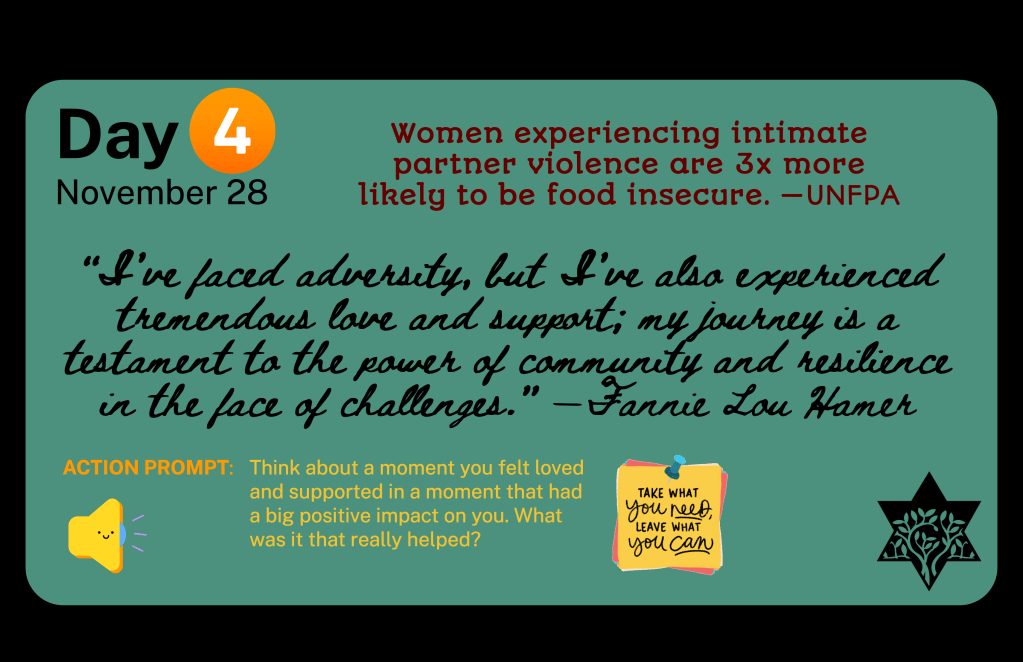
Yesterday we were invited to speak out, a topic which brings to mind Isaiah 58:1: Cry with full throat, without restraint; Raise your voice like a ram’s horn! Isaiah’s wisdom also relates to our focus today. Telling us not to fast to check a box in hopes of gaining God’s favor, but to connect with those in need and remove the binds of oppression for the sake of humanity. It is to share your bread with the hungry, and to take the wretched poor into your home; when you see the naked, to clothe them, and not to ignore your own kin. (Isaiah 58:7)
Fannie Lou Hamer organized around intersecting issues of oppression, including food insecurity. In 1969, Fannie Lou Hamer founded Freedom Farm Cooperative, 680 acres of land which helped poor families raise food and livestock to be able to sustain themselves beyond a single meal. “If you give a hungry man food, he will eat it. If you give him land, he will grow his own food.” — Fannie Lou Hamer
While our history of enslavement connects many black family legacies to farming through embodied wisdom that was adapted in a new environment, white supremacy has greatly impacted modern farming statistics for people of color. Black Farmers Index began as a project “to provide a small list of Black farmers to address the shortages of resources during the global pandemic” (— Our Roots: Black Farmers Index), asking “who would be affected first when there is a food shortage” and thought about being part of the solution. What started as 150 farmers has become 1,300 “small-to-medium sized growers, ranchers, poultry farmers, vegetable and fruit producers, grains and nut harvesters, beekeepers, fisherfolk, oystermen, foresters, foragers, vintners and more.” Of this number, more than 300 listings are organic farms, and over 400 are women-owned.
Black Farmers Index covers twelve regions, eleven across the comprehensive United States of America, including Alaska, Guam, Hawaii, Puerto Rico, and the Virgin Islands; and an International region of the diaspora that currently includes Canada, the Caribbean, and Central and South America. The legacy of Fannie Lou Hamer lives through bridging connections to land through growers connected to vulnerable communities.
While governmental support systematically excluded black farmers, less support has existed for indigenous farmers. The Native American Food Sovereignty Alliance seeks to research and preserve ancestral knowledge and pursue food sovereignty rights of Native communities to grow, gather, hunt, fish, and trade food in ways that are culturally grounded, environmentally sound, and economically just. “Land is the foundation of Indigenous food systems. Without access to land, Indigenous communities cannot hunt, fish, gather, farm, or practice the cultural and spiritual relationships that define food sovereignty. Yet across Turtle Island, the vast majority of land remains under settler colonial control. Land dispossession is both a historic trauma and a present-day barrier that Indigenous peoples continue to navigate.” (— Kaitlyn Walsh & Stephanie Morningstar, Six Pillars of Indigenous Food Sovereignty: Why Food Systems Work Must Go Beyond Access)
Northeast Farmers of Color Land Trust is one entity that highlights collaborations between black and Indigenous farming communities through its mission “to return land to Indigenous, Black, refugee, migrant, and diasporic land stewards of color as a means of advancing food sovereignty, healing, cultural celebration, and community self-determination.”
How have local farmers, social organizations, and individuals in your community been part of your reflection of the Day 4 statistic, prompt, and grounding quote…?


2 thoughts on “16 DAYS OF ACTIVISM – DAY 4”